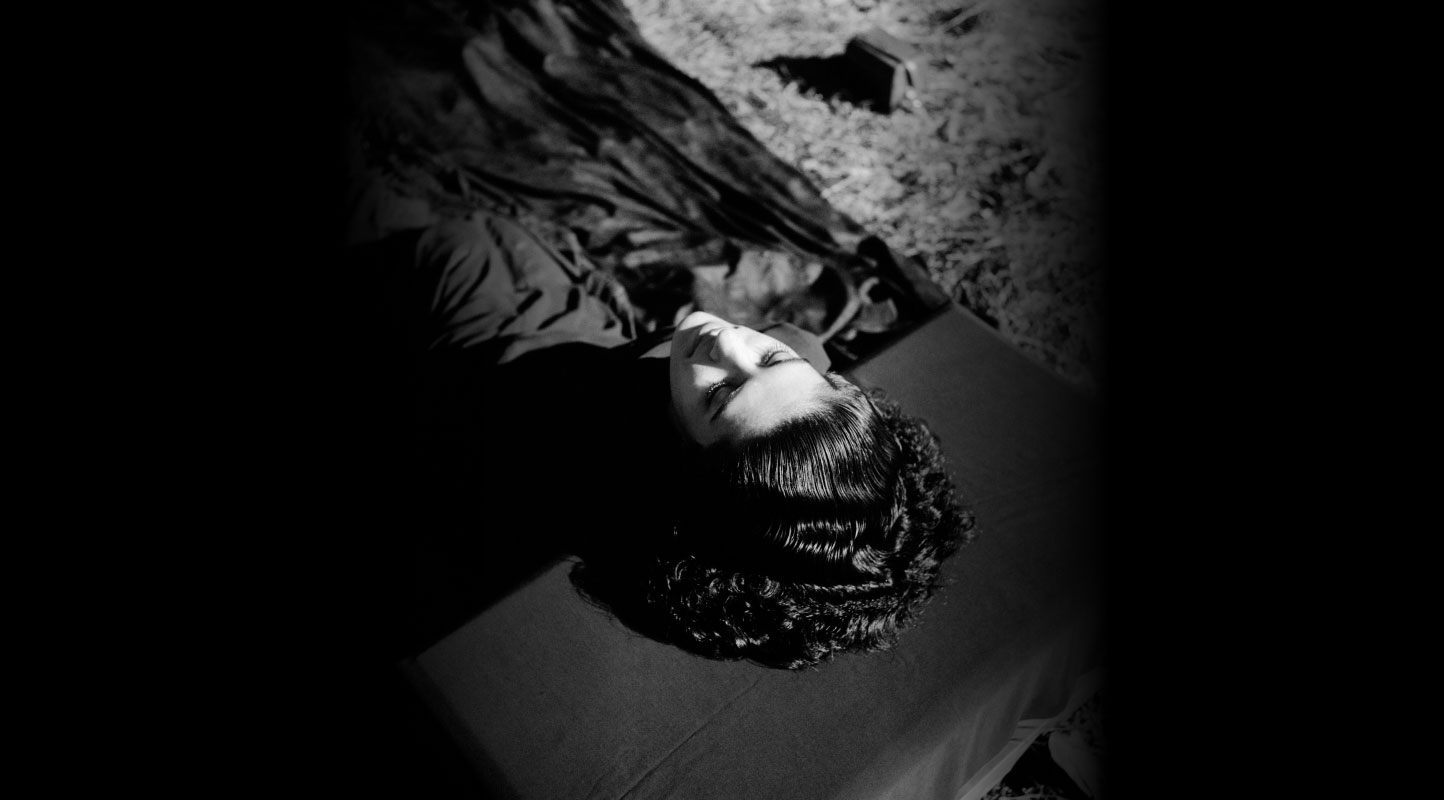


The Land Sings Back: Visions of Indigenous Futures
The Land Sings Back (2025)—a show that speaks in kaleidoscopic register of another world hidden in this one—brings together thirteen artists from the African, Caribbean and South Asian diasporas at Drawing Room, London. These artists draw from the well of our shared histories of indentured labour, transoceanic mercantile migration, decolonisation movements and inherited postcolonial structures and systems.. They emerge with half-dreams and guideposts towards a community-anchored and posthuman future. Here, human beings do not sit at the top of a hierarchy but are instead enmeshed in the natural world with non-human plants and animals as well as ecosystems and technologies. The philosophies underlying this lens (as opposed to an anthropocentric lens) can be found in indigenous cultures, as well as in the work of critical theorists like Judith Butler, Karen Barad and Donna Haraway, among others. Taken together we have a map in puzzle pieces for how to survive in an era of climate despair.
Natasha Ginwala notes in her curatorial essay how drawing was used by imperialists as a technology to taxonomise the natural world, allowing them to draft surveys that evaluate natural resources—away from a planetary commons and towards atomised modes of division and ownership. Whether in Namibia, Botswana, Sudan, Nepal, India or Sri Lanka, the colonial-era disruption of indigenous and native rhythms of forest-stewardship and knowledge of herbs and the land, has been carried forward into neoliberal regimes of governance that continue to extract, displace and subjugate these communities.
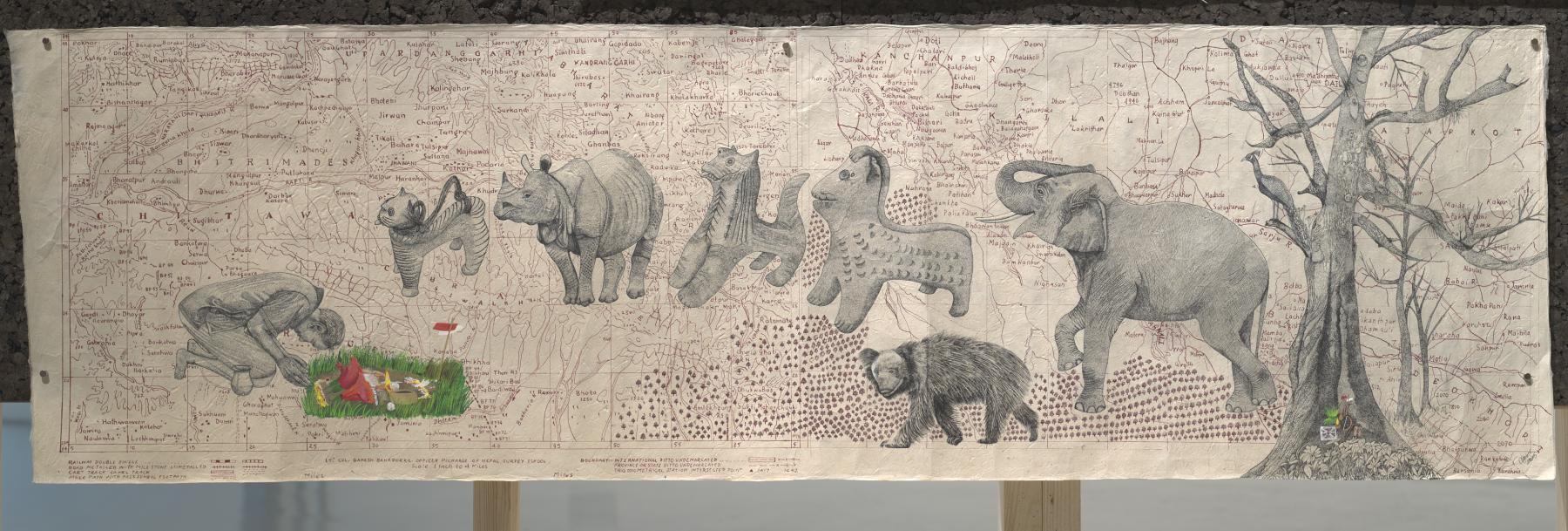
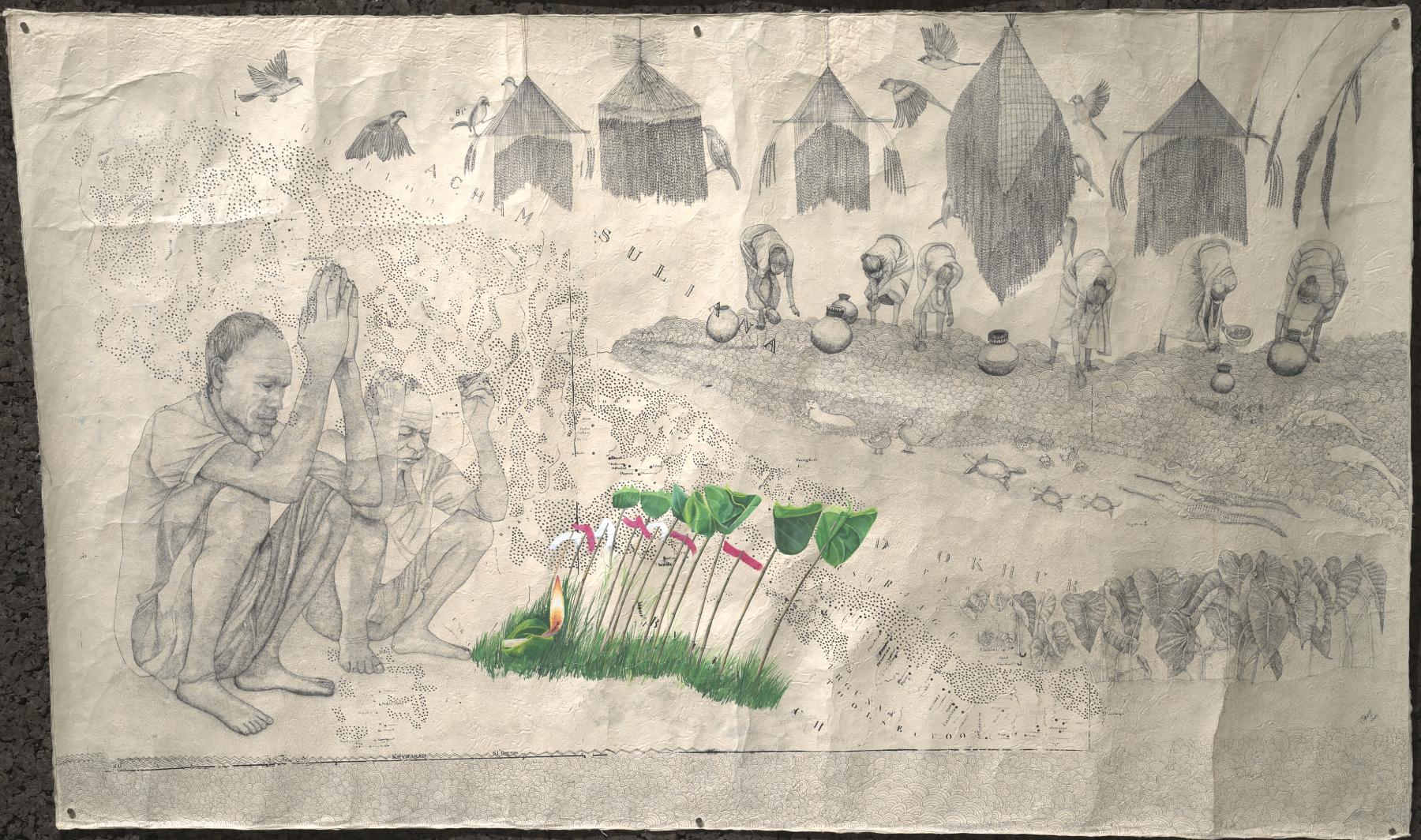
These contestations come alive in the striking triptych, “Banor” by Lavkant Chaudhary, who belongs to the Adivasi Tharu community from the Terai region in the southern foothills of Nepal. His body of work carries forward traditional knowledge systems, like oral history, seasonal dances and the Godna tattoo tradition, to create an informal archive of his community.
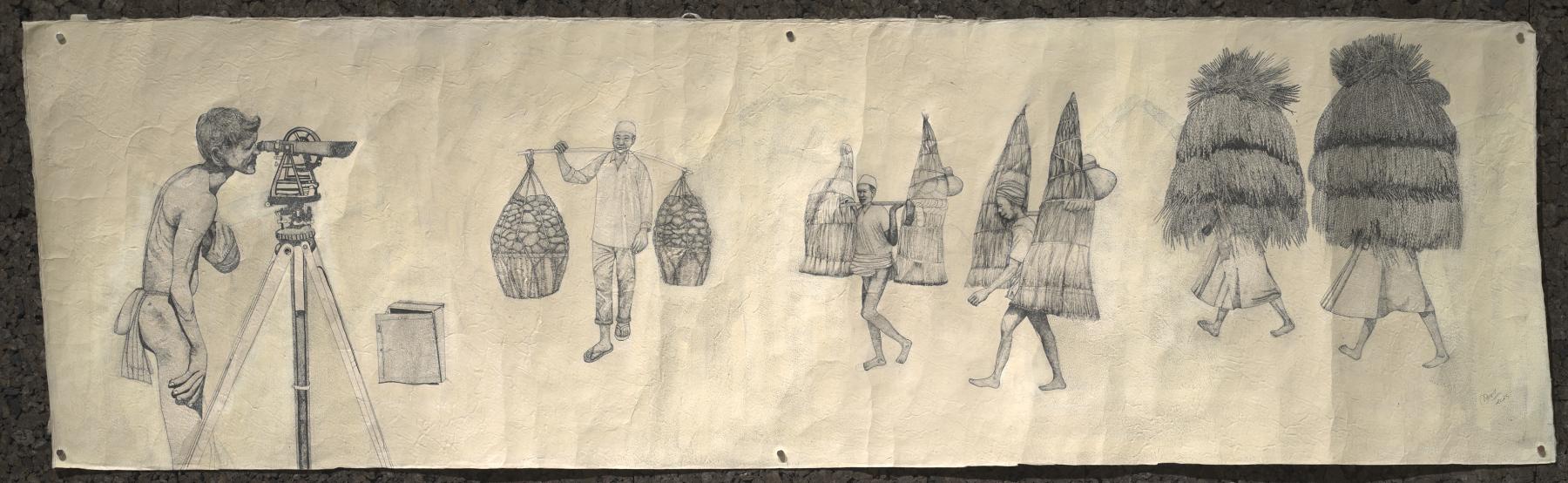
Using a Godna-inspired stippling technique on handmade Lokta paper, the artist juxtaposes cartographic logic with the actual beings that animate the land. The rhinoceros, tiger, cultivators in harvest season and vivid red hibiscus blooms, depicted in the traditional Tharu visual lexicon, dwarf the drab divisions that have forced the Tharus to migrate over the years. The nineteenth-century categorisation of Tharu as ‘masinya’ (enslavable) caste has manifested over the years as heavy taxation, displacement and bonded labour by the monarchy and corrupt governments. The community resisted, asserting their traditional attire, language and customs, and it is this spirit that Chaudhary stubbornly carries forward in his art, where the struggles for jal-jangal-jameen (water, forest, land) and an interdependence with animals tower over cartographic logic. History is also recorded in a different mode—not only textual but in Adivasi visual vocabulary, like the presence of the ghorwa (terracotta horse sculptures drawn from Tharu folklore).
.jpg)
Across the show, drawing is reactivated for its ‘reparative possibilities’ in such non-Western traditions where drawing itself is a knowledge system, as scholar Anna Arabindon-Kesson said, in her accompanying lecture. Artist Charmaine Watkiss, who is of Caribbean heritage, sieves from the horrific history of the transatlantic slave trade to rekindle a relationship between botanical illustration—like those by Sarah Mapps Douglass in nineteenth-century abolition-era Friendship albums—and matriarchal figures who embody the characteristics of the plants they work with as slave-labour in plantations. In her portrait, titled “The warrior exercises the right to dissent,” the woman is regal, adorned with a red and yellow frilled collar of Peacock flower, the seeds of which were used by enslaved Caribbean and African women to terminate pregnancy. The warrior’s arrangement of hands, with the red stamens extended out from her torso speak of composure and agency—dignity to be claimed even in the grisliest circumstances.
This wrenching of agency and recombination of forms—centering non-human and more-than-human subjects in portraiture—present possibilities for different kinds of interspecies relations in the future. Across historic visual cultures in Asia, we find ecofeminist iconography, nature spirits and fertility deities, which embody an ethos of communal guardianship also found in indigenous communities in the Americas and East Africa. There is a clear convergence in thinking, across these ancient nature-oriented cultures and contemporary environmentalist movement and critical theory. These histories thus present a way to envision the future at a time when the planet has been degraded by relentless extraction. In “Venus in Two Acts” (2008), Saidiya Hartman asks: “If it is no longer sufficient to expose the scandal, then how might it be possible to generate a different set of descriptions from this archive? … To envision a free state…?”
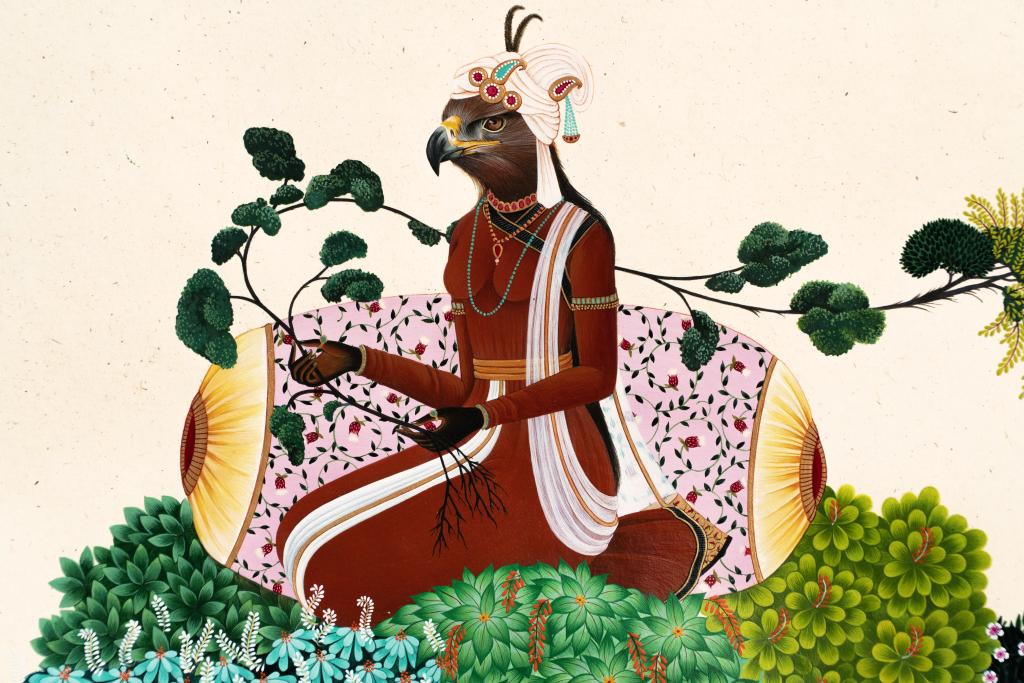
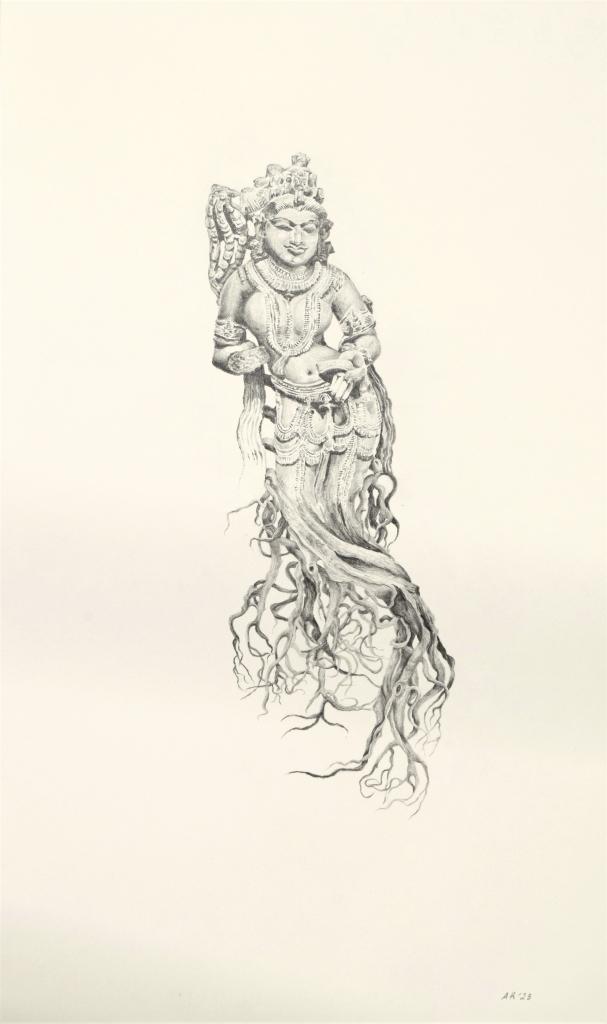
We find some answers in the transregional confluences of this show. Speculative leaps in figuration, dancing between history and future, mark Anushka Rustomji’s invocation of the talking waq-waq tree of Indo-Persianate mythology, Rupaneethan Pakkiyarajah’s invented ceramic alien-forms that encode time metabolised by land in Sri Lanka and Manjot Kaur’s stunning avian hybrids. Similar impulses as Watkiss’ characterise Kaur’s femme multispecies entities and Joydeb Roaja’s fine-grained linework—both of whom deploy hybrid forms. Kaur’s compelling tableaux subverts Pahari and Deccan miniature painting traditions to elevate non-human species, like the endangered blackbuck and steppe eagles, as custodians of their native grasslands. Roaja, also a performance artist, belongs to the Jumma Adivasi community from the Chittagong Hill Tracts of Bangladesh. In his large drawings, on one hand we have the Jumma people—branching into each other and foresting. In contrast, the “eaters of land intimately imbricated with state power,” as Naeem Mohaiemen writes, are depicted as macabre man-machine hybrids; their humanity reduced to miniature, pesky swarms in rejoinder to ongoing militarisation and persecution of the Jummas.
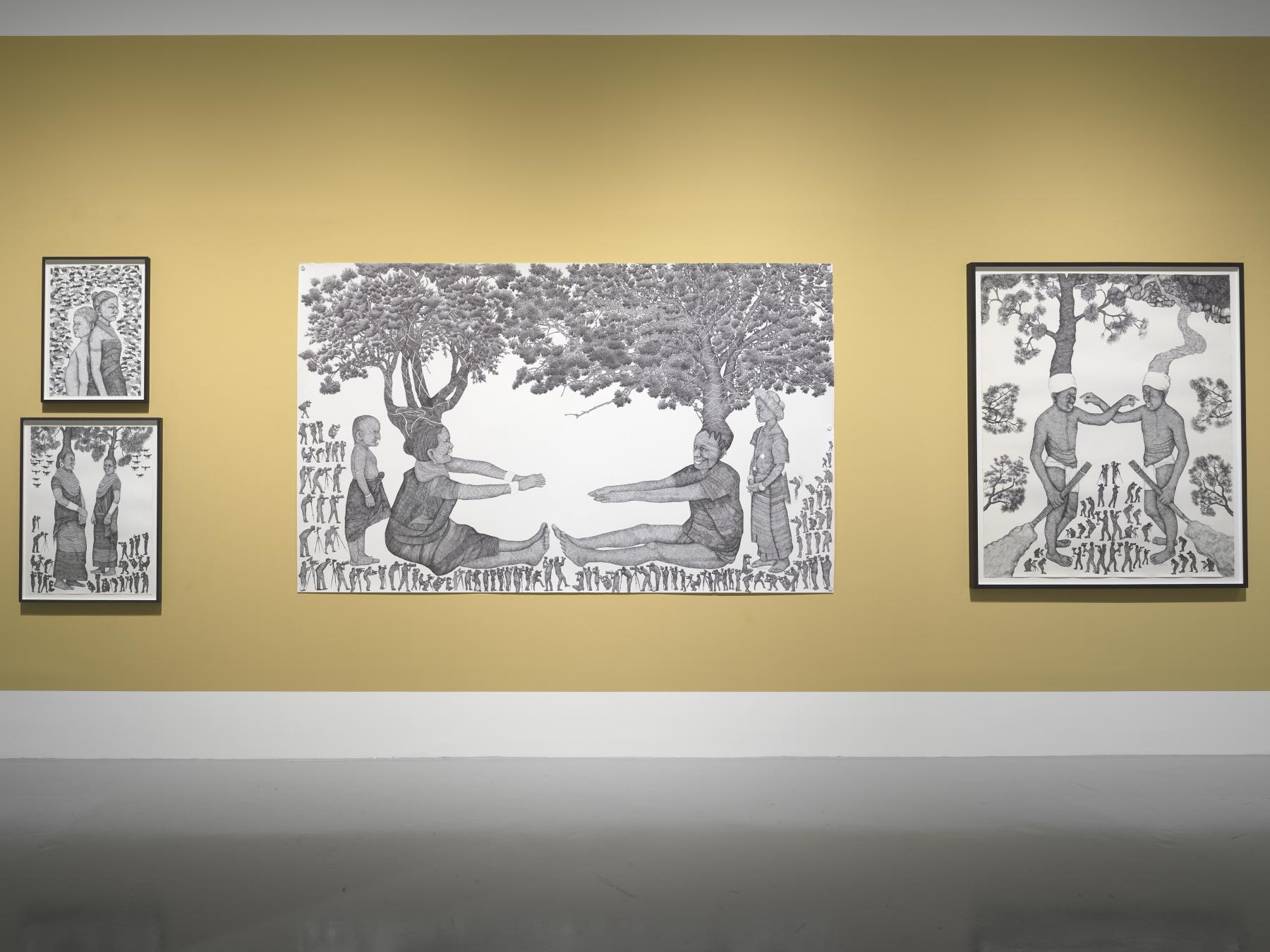
Hartman describes her method of critical fabulation as “straining against the limits of the archive” to write a cultural history of captives, attempting to “recuperate lives entangled with and impossible to differentiate from the terrible utterances that condemned them to death, the account books that identified them as units of value, the invoices that claimed them as property, and the banal chronicles that stripped them of human features.” The outcome of this method is a recombinant narrative. So does Roaja take the constitutive elements—indigenous peoples, jum cultivation, the military—and reorganise them to create the kind of recombinant narrative Hartman exemplifies. Drawing against the record of news headlines that consign the Jumma to casualties or military actions that would erase their presence, Roaja instead commits to the archive, their Risa weaves and their profound relationship with their land, literally transfiguring the people as one with vegetation—dignified and still there, despite repeated swarms.
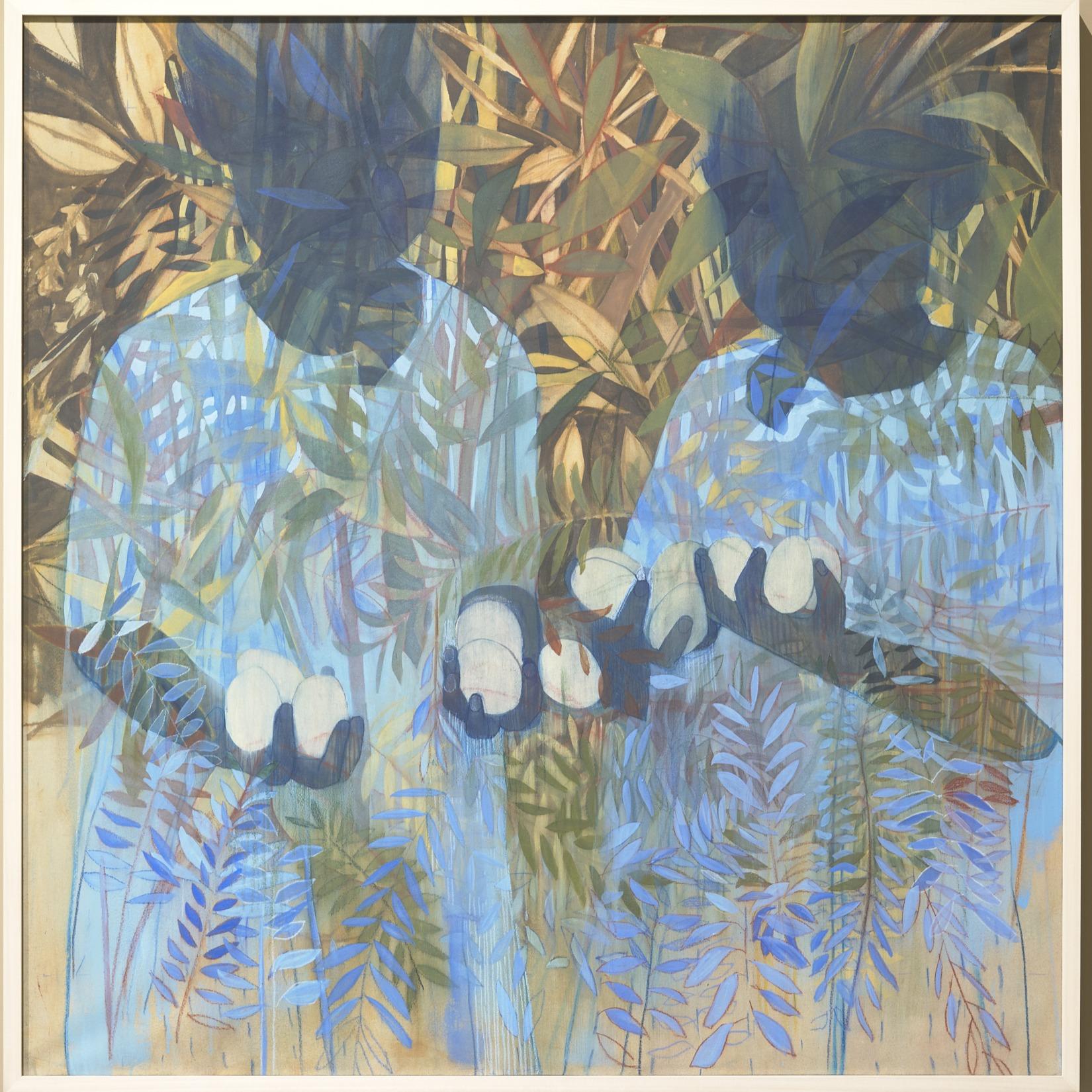
Roaja’s duo in “The Future of Indigenous Peoples #3” sprouting trunks and arms bridging together, faces clear and bright, built of vegetation, find kinship in Pamela Phatsimo Sunstrum’s summoning of secret selves in “The Dream II (mae).” The large, twinned-portrait hit me in the centre of my chest. Done in crayon, pencil and oil on linen, the slippery fluidity of the faces, leaves and limbs cast a spell, as if together a living, breathing organism. Sunstrum uses texture and the full spectrum of blackness to great effect here, fashioning her own legend. Olive green leaves in alternate phyllotaxy are layered on the doubled bodies; larger leaves turn indigo atop the blue-black surface of the faces; where they meet the pale blue of the dress, they turn blue as well. Sunstrom’s figures carry eggs. Hidden, they look at you.
.jpg)
These are works to linger with—all of them. They re-enchant our natural world, re-enchant drawing as a liberatory technology, and bring the emotional charge that dry headlines of planetary crisis cannot. It is the opposite of context collapse. Taken together, the works in this show restore context to the invisible labourers who held up tea plantations and are represented here by time-cards and tea-stains, for instance, in Arulraj Ulaganathan’s extremely moving work. They knit webs between the wounds of colonialism and present-day, where land is something that can be taken, and then must be ‘reclaimed’ through various bureaucratic exercises and largesse, and how these exploitative practices have hardened over time, wearing new skins through new governments that operate on the same lineages of logic, across plantations in Jamaica, Sri Lanka, Bangladesh and India. The Land Sings Back is a potent instance of Black and Brown intimacies—solidarity in action and ambitious in imagination as the artists align their ways of thinking about the natural world, the need to look back at indigenous traditions and stand against the extractive nature of the current status quo. It gathers the counter-histories and speculative imagination we need; as Saidiya Hartman dreams, their subjects are liberated from the obscene descriptions that first brought them to us.
.jpg)
To learn more about artists exploring post-human and speculative visions, watch Bhumika Saraswati’s conversation with Subash Thebe Limbu on Adivasi Futurism, read Najrin Islam’s essay on Arabfuturism in the works of Palestinian artist Larissa Sansour and Annalisa Mansukhani’s reflections on queerness and love in Tejal Shah’s video works.