

Minor Acts of Conjuring: Negotiating Hauntings of Political Ghosts
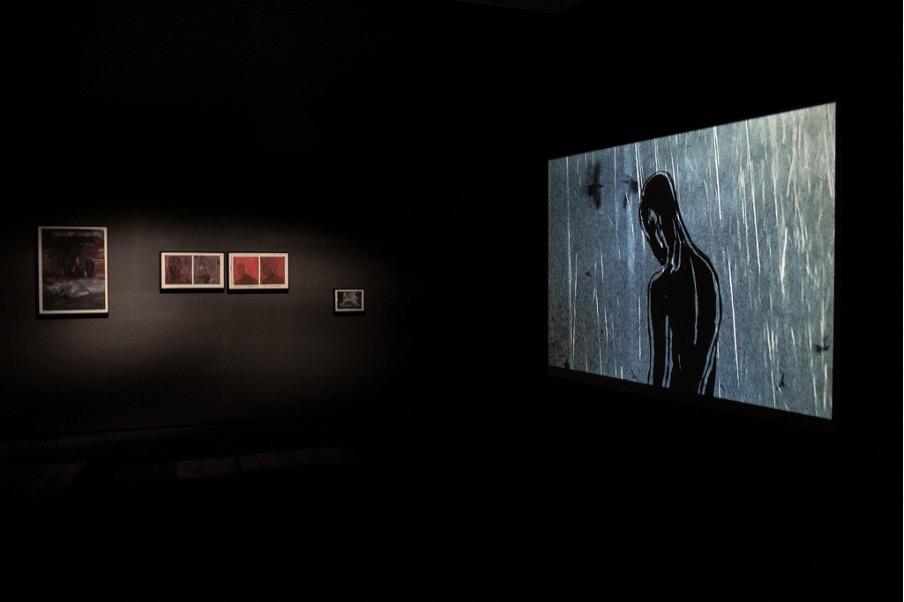
By nature, ghosts are haunting reminders of lingering trouble, writes Avery F Gordon in Ghostly Matters: Haunting and the Sociological Imagination (1997). However, she adds that haunting can be much more—touching the “ghostly matter of things” activates a confrontation with the “ambiguities, the complexities of power and personhood, the violence and the hope, the looming and receding actualities, the shadows of ourselves and our society” in all their vividness. In that sense, A Séance of Planetary Hauntings and Local Ghosts, the satellite exhibition of moving-image works at Emami Art Experimental Film Festival (EAEFF) 2026, curated by Sayanth RS becomes the holding ground for such encounters—a white cube transformed momentarily into a black box.
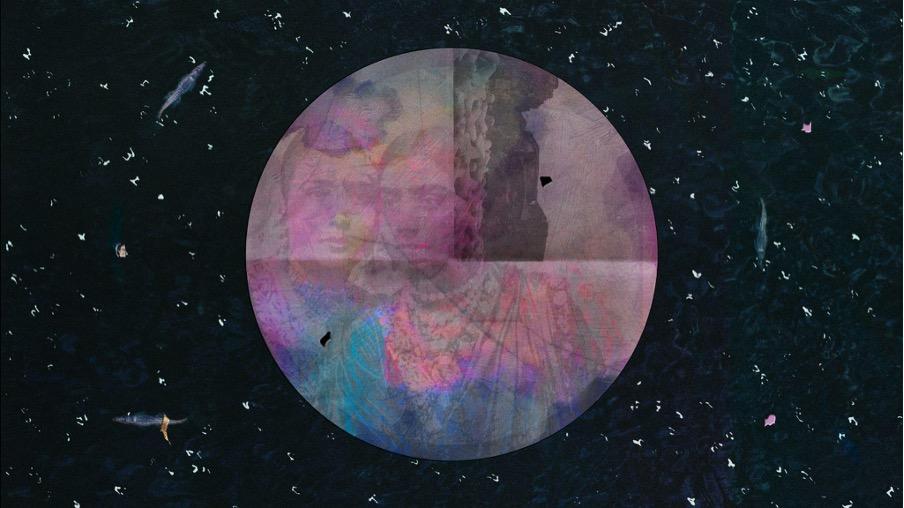
Still from Kaddukkas’ The Mapmaker from Baghdad (2026). Image courtesy of the artists.
Alongside the collective Kaddukkas, who are in the hot pursuit of the semi-fictitious location scout and amateur detective Rafique Baghdadi in their ongoing project, The Mapmaker from Baghdad (2026)—partially based on the eponymous fact-collector and film writer in Bombay—we fall into a rabbit hole of Baghdadi’s Bombay Standard Time which perforates linearity to make time into a malleable, loopy thing, and mapmaking an exercise in distraction and disintegration. Scatteredness characterises this map of serendipity where decades clash and coexist as poor images and videos scraped off the internet—as pop-ups on screen in the language of the early desktop era, infused with Baghdadi’s solitary and surreal experiences in capitalism central.
In a city that thrives on change, Kaddukkas foregrounds that certain things can remain unchanged across time, and trigger the same nervous responses—such as the experience of hearing the trill of a likely overfull Bombay local or the quick-anxious paces of morning officegoers perpetually wishing they could move faster. In the artists’ unregistering of the city, everything shifts into a blur of transit, replicated in the images and videos which materialise on screen. What then of archiving a city that constantly shifts and turns, as someone mentions how they fail to recognise Andheri Bridge each time they move through it.
Kaddukkas marks out Baghdadi’s Bombay—which leaks into present time in sounds and unidentifiable photographs—while eavesdropping on conversations that churn out stale lores about the concrete beast; for instance, a man passing by remarks that to survive in Bombay, one must have one’s eyes and wits around them. Amidst these interventions, minor acts of conjuring suddenly bring up artefacts and figures from a nascent Bombay film industry such as Vilas who opened the first movie theatre near Bandra Station, or the actress Khursheed, who still rehearses her lines for a meta-narrative.
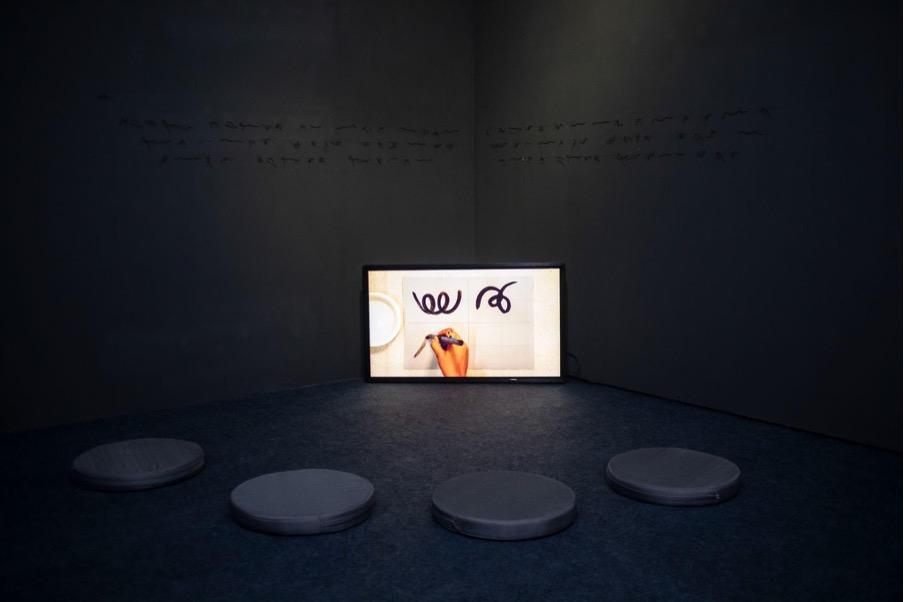
Baghdadi’s five-hour night crawl demands us to be momentary companions, flitting in and out, much like artist Arpita Akhanda’s two-hour-long durational performance film When the River Becomes Snow (2026), where a brush dipped into a mound of snow paints ephemeral looping forms over brown paper, evoking the childhood activity of mark-making. She invites us to sit and watch as the lines evaporate and are revived again by her, as alternate forms. These figures and exercises of the imagination are revealed to be broken pieces of barbed wire which latch themselves onto the walls surrounding the screen, forming an undecipherable yet familiar alphabet of oppression. In an earlier work The Last Leap: 101 Ways of Crossing (2020), Akhanda is a spectral presence whose body grapples with moving through and under barbed wire, as she resurrects the histories of cross-border migration during the 1947 Partition, carrying the generational trauma within her own body, which her work persistently returns to. However, here, it also holds the possibilities of other narratives of border surveillance and renegade movements that are fuelled by the desire to cross over in an everyday reality of genocide and wars.
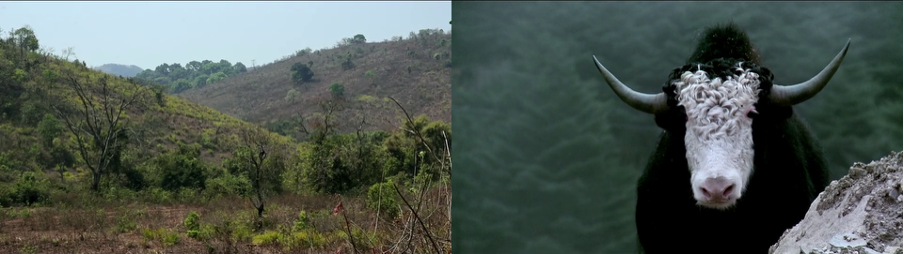
Made from snow, Akhanda’s strokes acutely recall the wires’ omnipresence in the heavily armed and surveilled Kashmir as seen in Sohrab Hura’s Snow (2015-19)—where he insinuates how the picture-perfectness of touristy snow in Srinagar can become distracting enough to ignore the manufactured illusion of serenity and the reality of Kashmiris being subjected to atrocities by the Indian government. Akhanda moves towards acts of remembering while collapsing these two extremities just as the documentary filmmaker Nilanjan Bhattacharya does in his film Quiet Flows the Stream (2026), which is located beside her work and shows panoramic shots of clouds rolling over snow-capped mountains in Lachung, Sikkim. These are punctuated with a helicopter flying through, as traditional medicine practitioner Thendup Lachungpa mentions not being able to visit his teacher who taught him these practices in Tibet due to India closing borders with Tibet.
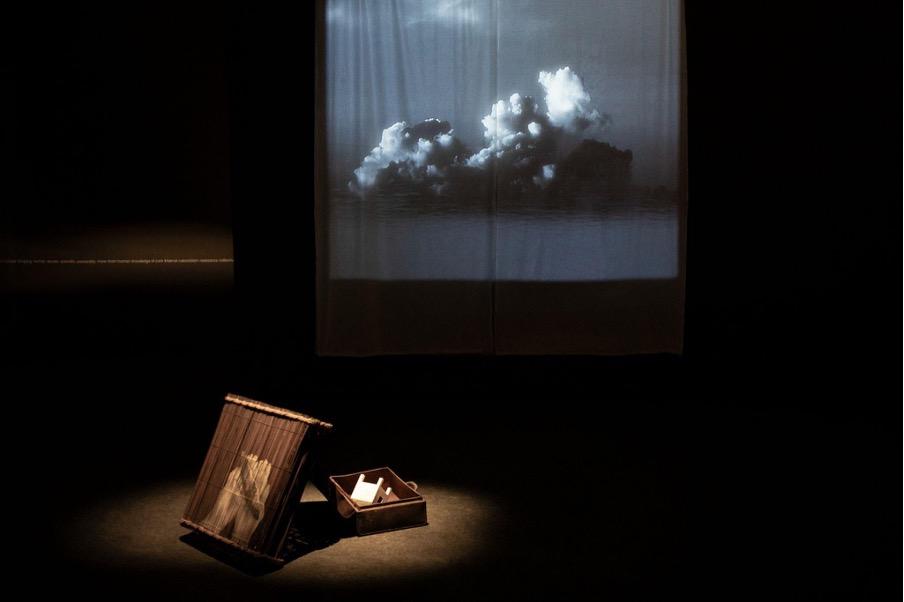
Bhutan has been releasing dam water into Assam over many years now—particularly from the Kurichhu dam—sometimes through governmental coordination, despite regular episodes of flooding as an aftereffect which puts the lives of Assam’s citizens at risk every time this occurs. Moreover, sometimes these inflows are uncontrolled or even unannounced which catches Assam off guard, like earlier this year, although the Bhutan government has denied doing this. In Pankaj Sarma’s film তথাপিও নদীখন েবৈয় আেছ (And Yet, the River Flows, 2026) a phantom loudspeaker floats in the air as a constantly returning haunting figure that warns everyone to keep their documents safe since the Bhutan government would be releasing water over the night.
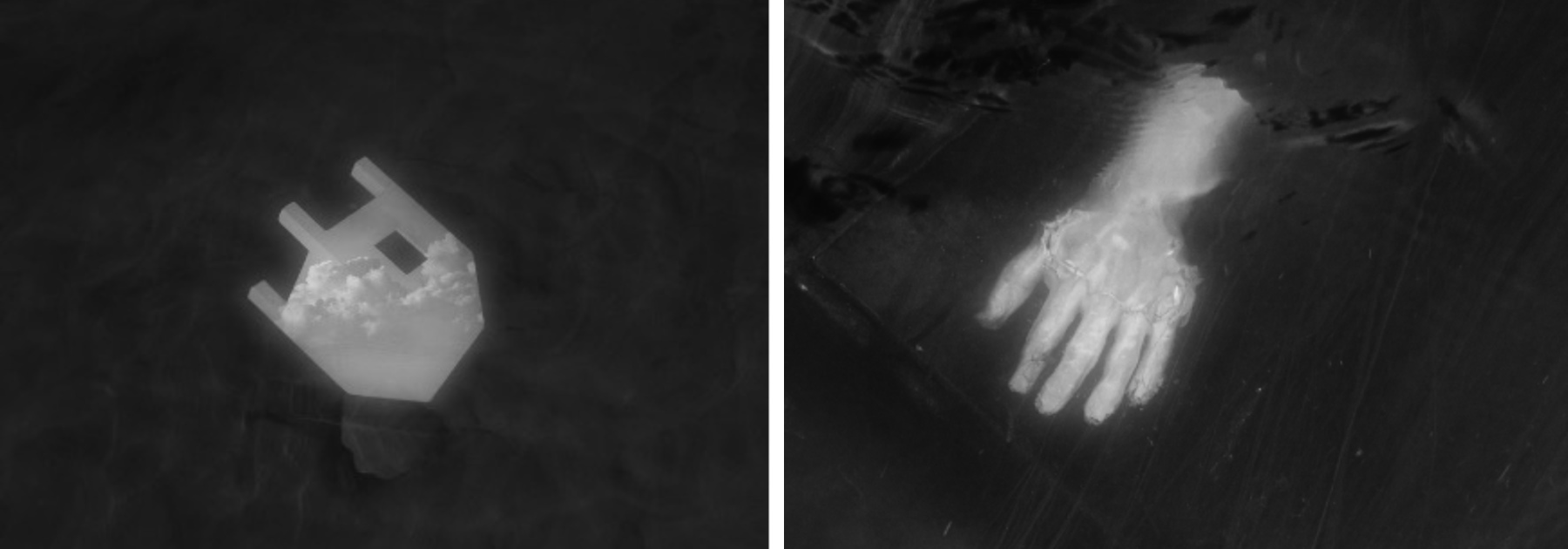
An upturned house floats on stilts like the ghost of a blueprint, a thwarted rendering or a phantom which once had been actualised on ground until the river bloated till it reached the skies, submerging the land within a subterranean world. Gentle markers of physicality meld with the calm ripples of the river hiding its insidiousness until it throws up objects such as an anonymous photograph in which Sarma seems to recognise his own face, floating towards an inescapable fate. Sarma’s narrative ebbs on a quietude reminiscent of photographer Swastik Pal’s decade-long documentation of the precarity of climate migration in the Sundarbans. While his narrative might seem to bear notes of resignation, Sarma embeds within it a sharp ire which transposes a political narrative of man-made floods onto the riverine as he wonders: if the river asks him about his address, what would he say?
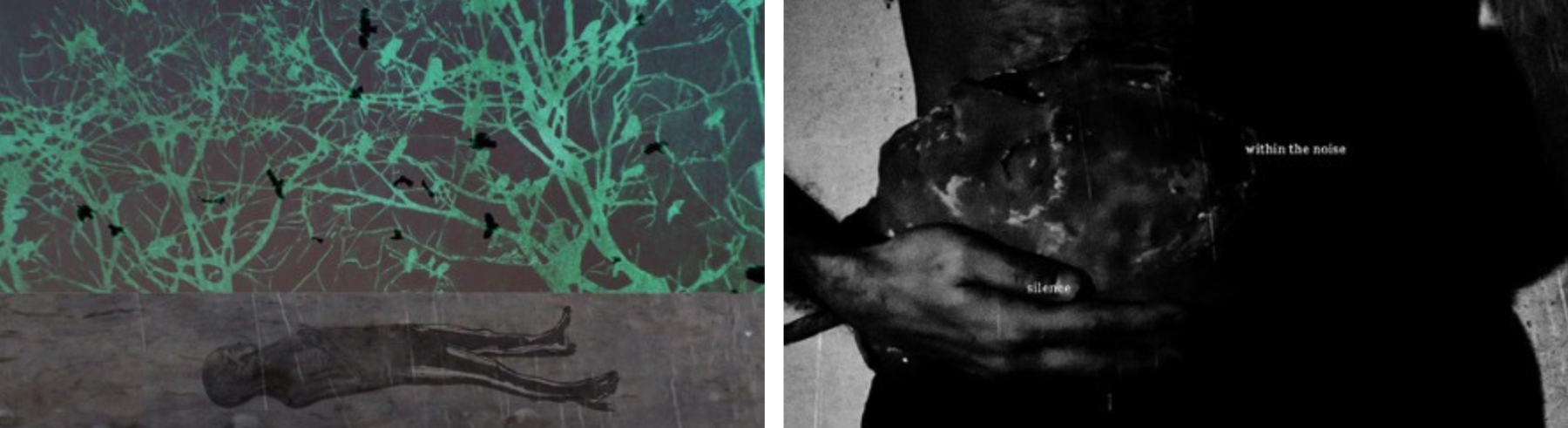
In the language of animation, filmmaker Ushnish Mukhopadhyay works through bereavement overhung with the spectre of industrial capitalism in Bengal, taking the case of the shuttered Hind Motors factory where his father worked until it was shut down overnight, leaving all of its workers unemployed. Not delving deeper into this scenario, Mukhopadhyay constructs a vocabulary of grief rendered in repetitive physical acts of embracing, holding, caressing and brushing away—a realisation of their cloying monotony underneath pressing waves of sorrow. These are reminiscent of other gestures of grief, such as the emotive registers in Priyadarshini Ravichandran’s Surge (2019).
Alongside self-portraits made from gaunt renderings of Chittaprosad Bhattacharya’s figurations during a different man-made colonial disaster of the 1943 Bengal Famine, Mukhopadhyay turns the lens towards his own body. It twists and turns the avian and amphibian in its desire to occupy a different state momentarily, shifting from familiar-familial gestures towards something bordering the primal.
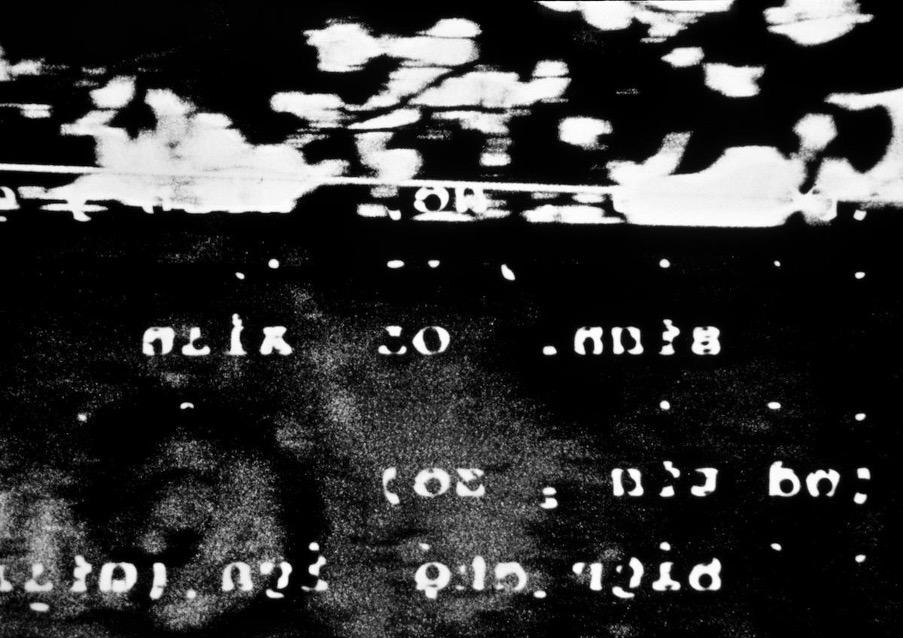
The filmmaking duo Solomon Nagler and Alexander Larose’s Wedding Songs (2025) too excavate an alternate language of looking, also seen in their earlier film J (2008), where blotches of colour morph into figurations of violation. Here, the film runs like a visual accompaniment to Rochester’s narrative in Jean Rhys’ Wide Sargasso Sea (1966), where he attempts to comprehend the flora of the Caribbean and the intoxicating smells which slither beyond his grasp. Like Rhys, the duo’s camera seems to grapple with a new language of the miraculous, which the patron saint of the Malabari Jews, Rabbi Nehemiah Ben Abraham Motta, is said to have performed in Cochin. The gaze rests on his grave, one of the few left from the community after the land was sold to or taken over by state bodies, in an ironic version of “settling over” land even as Jews from Kerala migrated to Israel during the 1950s-60s.
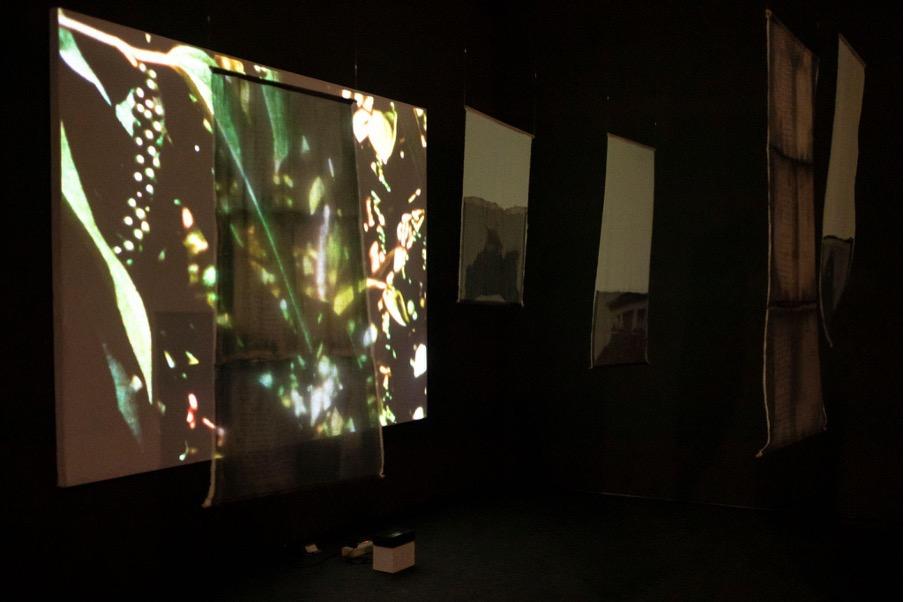
Pixelated like found footage, perhaps the only language to encapsulate the supernatural sans its presence was through a hallucinatory search, furthered by coloured silk screens placed above the projection screen—each offering a distinct surreal view. It is a pivotal moment to consider the context of the Rabbi—whose remains were wanted in Israel and where a street is even named after him—at a time when Goa and Himachal Pradesh have become places of refuge for Israeli soldiers engaged in the genocide of Palestinians. Perhaps beyond invisible spirit matter, the long arms of the state and national machinery hang as extremely visible phantasmagoria over narratives—each coming from a different part of India—recurring across the decades in shapeshifting iterations, acting as signals of trouble, more than anything else, as Gordon implies.
To learn more about the previous edition of Emami Art Experimental Film Festival, read Mallika Visvanathan’s conversation with Richard Tuohy and Dianna Barrie on sound design and their work at nanolab and Asmita Pal on her short film A Very Clear Sunrise (2025), Ritam Sengupta’s essay on Pinak Banik’s film Obsolete Skygazer - Enlightened Observer - Ignorant Truthseeker - Emaciated Entourage (2025), Santasil Mallik’s observations on Maha Haj’s Upshot (2024), Vishal George’s review of Mohammed Jassim’s documentary Bar Saar (2023) and Ishtayaq Rasool’s essay on Fileona Dkhar’s Ancestral Echoes (2022).
To learn more about artists mapping territorial negotiations, capital accumulation and minoritisation, read Najrin Islam’s reading of image politics in Palestinian films and representation as resistance, Kshiraja’s review of Sara Saini’s film on 1992 Burnsall Strike, Ankan Kazi’s reflections on documentaries focusing on legacies of The Partition and present-day communal violence in Eastern India and Habibur Rahman’s The River of Partition (Ichamati, 2023), Mallika Visvanathan’s conversation with Biswajit Das and Chandan Borgohain on their documentation of culinary traditions near the shrinking Kulsi river, Jigisha Bhattacharya’s exploration of Sohrab Hura’s series Snow (2015-19) that looks at the complex realities of Kashmir, and Shaon Basu’s essay on Somnath Hore’s Tebhaga Diary.