

Kashmir: The Poem and the (Impossible) Picture (Part One)
The text below may be read as a series of fragmentary reflections on two journeys to Kashmir: one by Qudsi Mashhadi, a seventeenth-century Mughal court poet who wrote masnavis (rhyming couplets) in Persian on the hardships of the road to Kashmir, and the other by Samuel Bourne, a nineteenth-century British photographer who recorded his photographic expedition to the valley in his letters to the British Journal of Photography. How do these “pilgrimages” into the limits of vision, language and representation speak to us, if they speak to us at all?
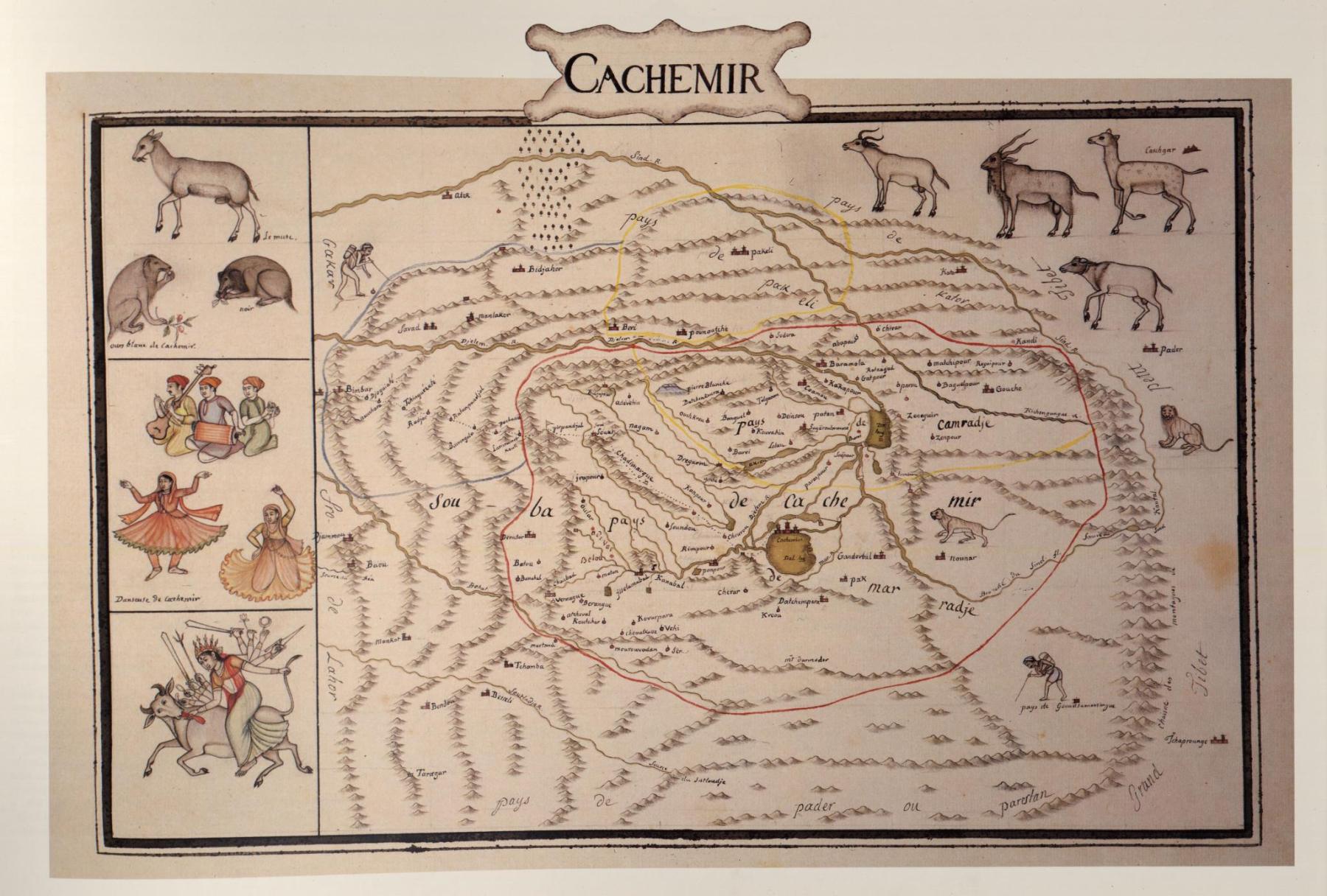
Illustrated map of the Kashmir Subah of the Mughal Empire, commissioned by Jean Baptiste Joseph Gentil. (c.1770. Source: Wikimedia Commons.)
1. In the summer of 1634, Qudsi Mashhadi, the poet laureate of Shahjahan’s court, accompanied the emperor on his trip to Kashmir. The royal entourage started from Bhimber in the Punjab plains and took the steep, spiralling Rah-i-Shahi (imperial road)—through the Pir Panjal mountains into Kashmir. A difficult, imposing and inhospitable passage into the valley, Qudsi wrote descriptive, vivid and lyrical verses about the journey and arrival. Akbar, who had annexed Kashmir in 1586, made his first visit to Kashmir in 1590, most likely accompanied by his court poets Faizi and Urfi. They composed verses in which Kashmir and the Mughal emperor were exalted together, symbolising the union of the gardener and the garden.
Conquest of Kashmir as a poem.
2. The British photographer Samuel Bourne arrived in colonial India in 1863 and spent seven years photographing and documenting the subcontinent. In the summer of 1864, he set out from Chamba in the Punjab hill states, on a photographic expedition to Kashmir and its surrounding environs. His journey the previous year to Shimla had fetched mixed results: “scenery not so well adapted for the camera.” The observation points to the emerging logic of a new ocular regime. “I have no doubt that in some parts of the Himalayas, grand and striking views are to be found…” For Bourne, the views existed; the challenge was in discovering the vantage points that offered the ideal, ordered perspectives for photography. He hoped to find them in Kashmir.
Conquest of Kashmir as a photograph.
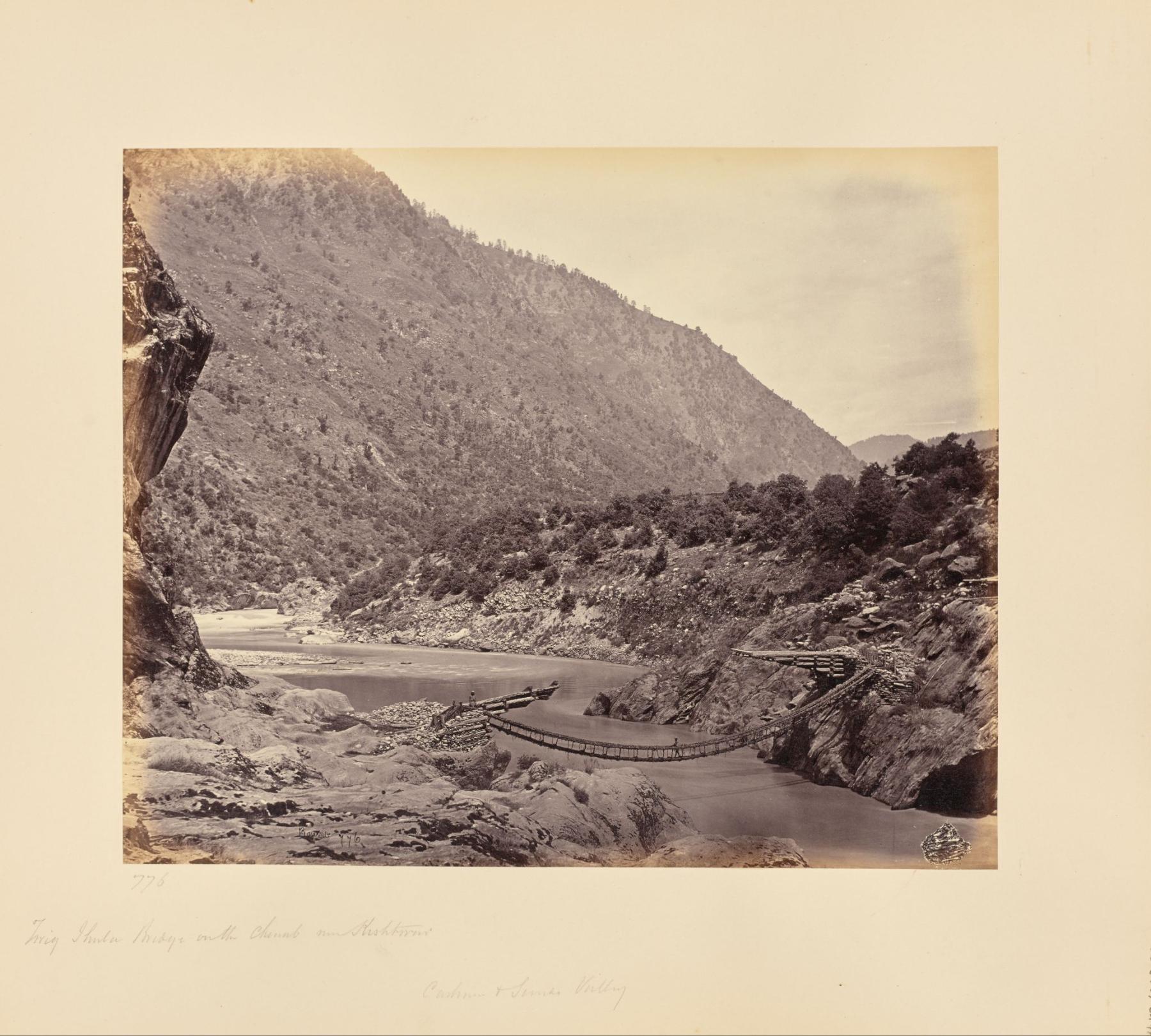
Twig Jhula Bridge on the Chenab, near Kishtwar. (Samuel Bourne, 1864. Source: Getty Images.)
3. For Qudsi, to take the road to Kashmir is to be initiated on the path.
ره فقر از ره کشمیر پیداست
که گام اول آن، ترک دنیاست
The path of spiritual poverty is revealed through the path to Kashmir,
For its first step is the renunciation of the world.
Take the first step on this calamitous path to paradise and leave the world behind. Its trials and tribulations are too many. One starts the journey with prayers, supplications, and appeals; one walks, but always under the shadow of divine terror:
معاذالله ز کوه پیرپنجال
که مثلش دیده کم، چرخ کهنسال
God save us from Pir Panjal,
A rarity not beheld, even by the ancient heavens
In his masnavi, Qudsi transformed his journey into a pilgrimage, to a place that promises beatitude. The blessed garden beckons, but the poet has no faith in the path:
به کشمیر اعتقاد ما درست است
ولی ایمان به راهش سخت سست است
In Kashmir, our trust endures,
But our faith in the path is feeble.
4. Bourne started from the outer Himalayas, chasing the picturesque in the south-eastern stretches of the Pir Panjal mountains of the upper Chenab valley and Kashmir. Across the river and along it, the difficult routes and impossible treks, through freezing nights and dizzying heights, he wanted to discover landscapes, the photographs of which he would not be “ashamed to send back to England,” where the appetite for the picturesque, exotic views of colonised South Asia was fast growing. Resolute and determined like a pilgrim, he obsessively sought “pleasing and enjoyable views.” However, as he proceeded onwards, the scenes began to get too wild and chaotic for the camera, and refused its fragmenting, violent gaze.
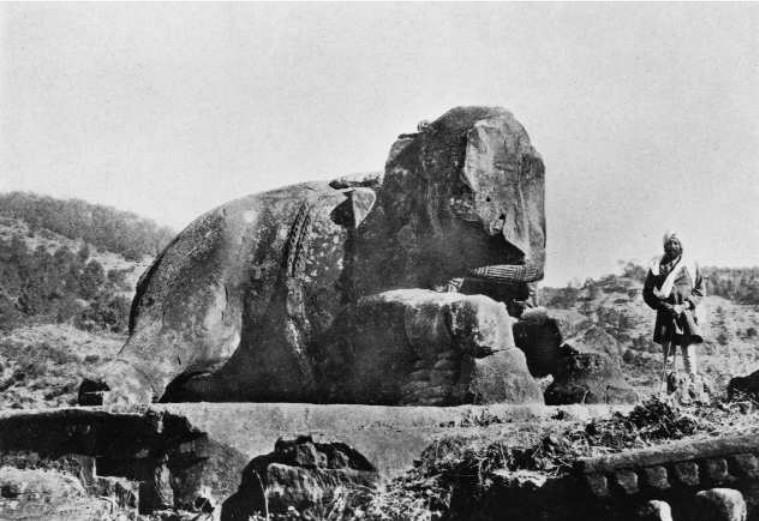
Sculpture of an elephant at Hathinala Pass near Naushera, at the foothills of Pir Panjal. Commissioned by Jahangir in 1625 while travelling from Kashmir to Lahore. (1917-18. Source: Archaeological Survey of India.)
5. In Qudsi’s poetry, the Pir Panjal is depicted as a savage, fearsome enemy, with its sword drawn, ready to ambush the approaching travellers. The road is presented as a series of prospects—overwhelming and petrifying—of vertiginous heights, precipitous drops and biting cold winds. Of narrow winding paths where travellers arrive at their destination, spent and exhausted, if they have not already fallen to their deaths. And if they fall, says Qudsi, they fall like pearls from a broken string.
ازین ره چون توان آسان گذشتن؟
که گام اول است از جان گذشتن
رهی همچون دم شمشیر، باریک
جهان در چشم رهپیماش تاریک
رهی پیچیدهتر از موی زنگی
به تندی چون دم تیغ فرنگی
How does one travel on this road with ease,
When the first step demands the soul's surrender?
A path, narrow like a sword’s sharp edge,
Makes the world grow dark in its traveller’s eyes
Twisted, like a dark, curled hair,
And swift as a Frankish sword
The poet even claims to have seen heaps of elephant bones in the valleys of Pir Panjal. The giant beasts probably failed to balance their mass on the narrow tracks and fell to their death. (Jahangir certainly lost his two favourite tuskers to these mountains.)
But Qudsi is certain that arrival in the valley would heal all the rigours of his journey. Beyond the spiritual ordeal of the pilgrimage, the garden awaits.
6. Bourne called himself the disciple of the camera: “Before commencing photography, I did not see half the beauties in nature as I do now.” The nineteenth century is that critical and consequential moment in modern history when the photographic image insists and persists as the only site of revelation. Whatever is revealed, it is through the eye of the new equipment. It teaches a new way of looking at the world, with violence that plays out through distance and detachment, observation and control. The camera confirms what Heidegger called “the age of the world picture”, where the world, the being itself, is "grasped as a picture.” The triumph of representational thinking. European modernity embodied in a black box; disciplining, fragmenting, and isolating the world. Revealing it through the camera’s frame. But what reveals also re-veils. Visibility afforded by the specular and spectacular regime of modernity might not, after all, allow us an insight into what is visible.
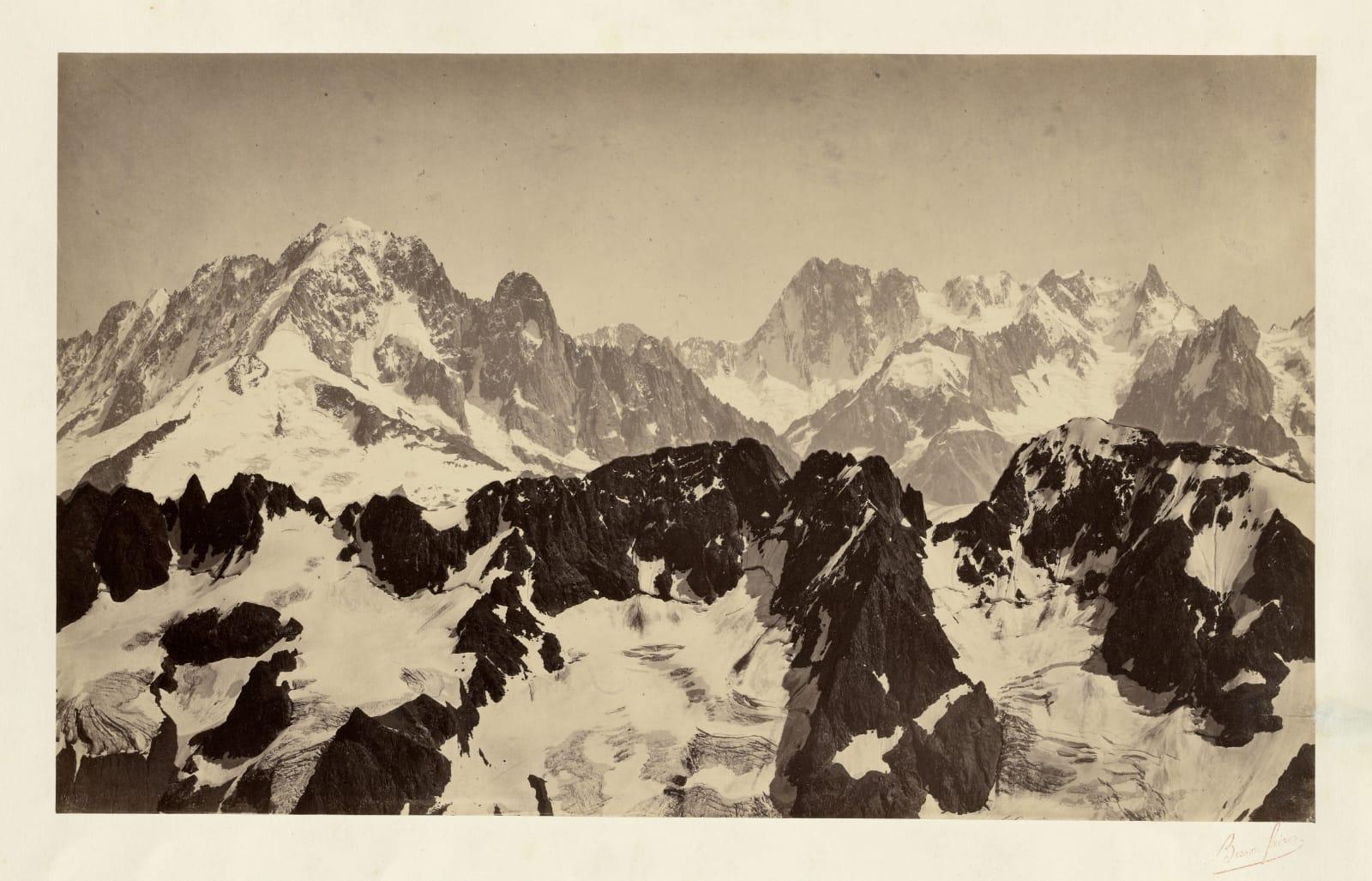
View of the Alps. (Bisson Frères, c. 1860–61. Source: Getty Images.)
7. Qudsi was fifty-two-years-old when he made his trip to Kashmir. The scenes on the way must have been too overwhelming and awe-inspiring for his sensitive poetic temperament. As a distinguished senior poet of the court, Qudsi’s role was defined within the poetics and politics of Mughal sovereignty. He was, however, also aware of his deeper, sacred connection with the legacy of the poetic speech: Sukhan. In serving the emperor, the poet also served Soroush, the angel of inspiration in the Perso-Islamicate spiritual and literary traditions. One of his Kashmir poems hints towards a temporary block in his poetic output, until Soroush urged him to sing and reveal what he had seen, for primordial poetic speech is the principle of creation:
سخن اصل وجود کاینات است
سخن پیرایه ذات و صفات است
Speech is the true nature of the existence of the universe;
Speech is the adornment of the Essence and the Attributes (of God)
And it is the poetic word that truly reveals, for revelation is the Book as well as the Universe. At the origin of both is the creative, eternal speech کن (Be) . नाद (Primordial Sound/ Call).
8. Intimidated by the immensity of Himalayas, Bourne hardly finds them picturesque. Once again, he complains: “scenery not so well adapted for the pictures.” The scenes in the Himalayas are compared with the Alps of Switzerland, which he knows only from the photographs. Himalayas are "not so naked in their outline, not so detached… wanting in variety." The domesticating urge of the Englishman is confronted with what he has never experienced before, what Bachelard calls "immensity with no other setting than itself." Vision runs wild, resisting capture by backgrounds, foregrounds, frames and boundaries. Spatial and temporal infinity is experienced and mirrored in the finitude of the human heart.
To learn more about Samuel Bourne, read Avrati Bhatnagar's essay on the introduction of the medium in India, and Ankan Kazi's review of Reverie and Reality: Nineteenth Century Photographs of India from the Ehrenfeld Collection.
To learn more about artists engaging with the representation of Kashmir, read Irtiza Malik’s fiction piece Kitna Yaad Thayega?, Jigisha Bhattacharya’s essay on how Sohrab Hura sees Kashmir as an outsider in his work Snow (2015-ongoing) and Najrin Islam's curated album from Moonis Ahmad Shah's Telegrams to Bollywood from a Mad Landscape Scout (2017–18).
All translations are by the author.