

Emerging Voices: Surveying Printmakers in Eastern India
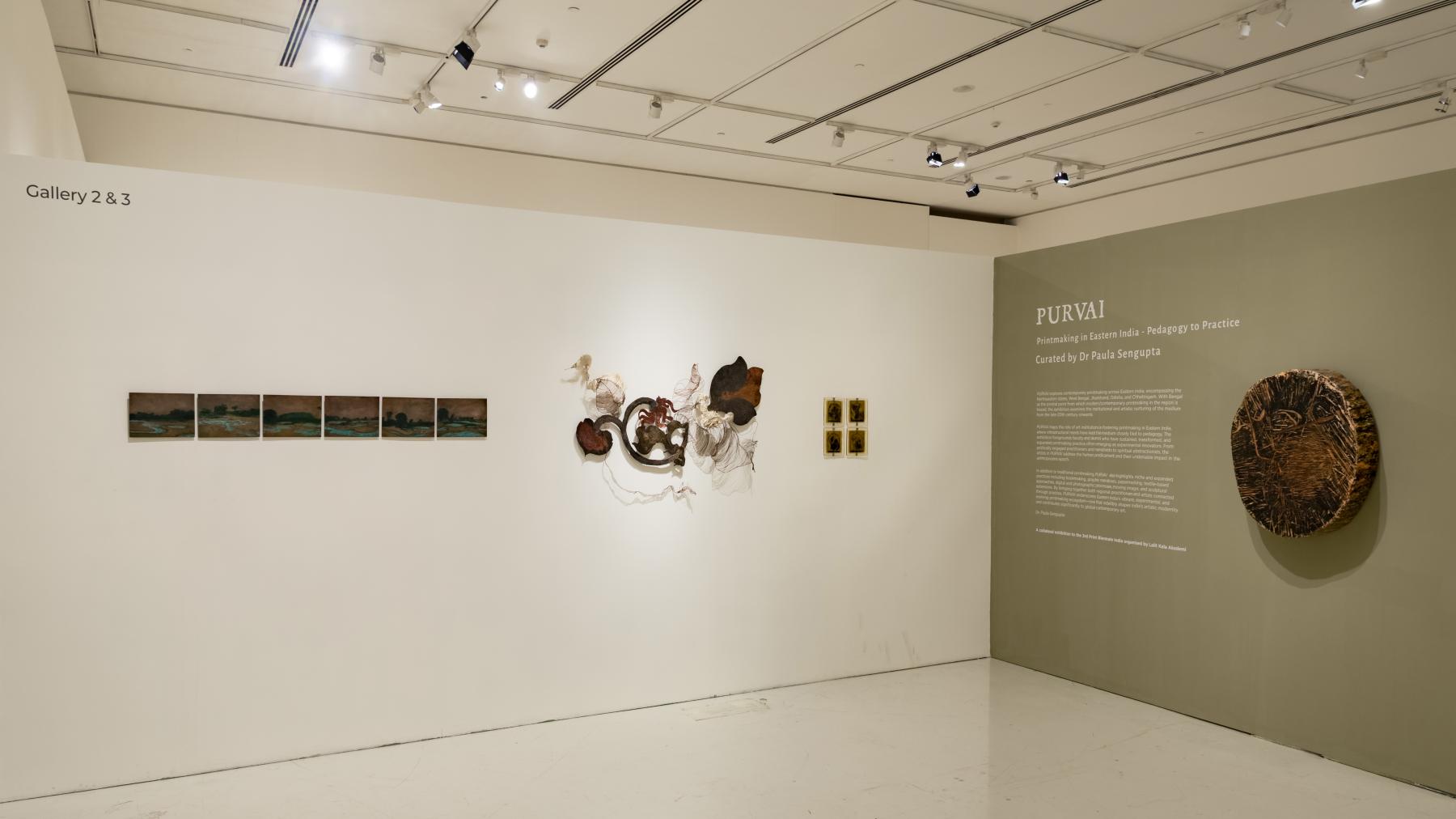
The survey exhibition comes with its own rewards and pitfalls within an all-encompassing ambition, as art critic Nageen Shaikh wrote. To embark on a survey of contemporary artistic printmaking in eastern and northeastern India is a daunting task, considering the sheer expanse. Curator Paula Sengupta undertook this endeavour in PURVAI: Printmaking in Eastern India – Pedagogy to Practice, held from 9 January to 7 March 2026 at Emami Art, as a collateral exhibition in conjunction with the third Print Biennale in India.
Albeit it is familiar ground for Sengupta, who worked on two commendable volumes, entitled The Printed Picture: Four Centuries of Indian Printmaking (2012), where she looked at the Delhi Art Gallery collection of Indian modern art from the eighteenth century onwards. The books chart the advent of printmaking in the country through the introduction of printing presses and foreign artists adept in the medium travelling to India for the first time—after which printmaking was taken up by art school faculty and later by twentieth-century artist collectives across the country.
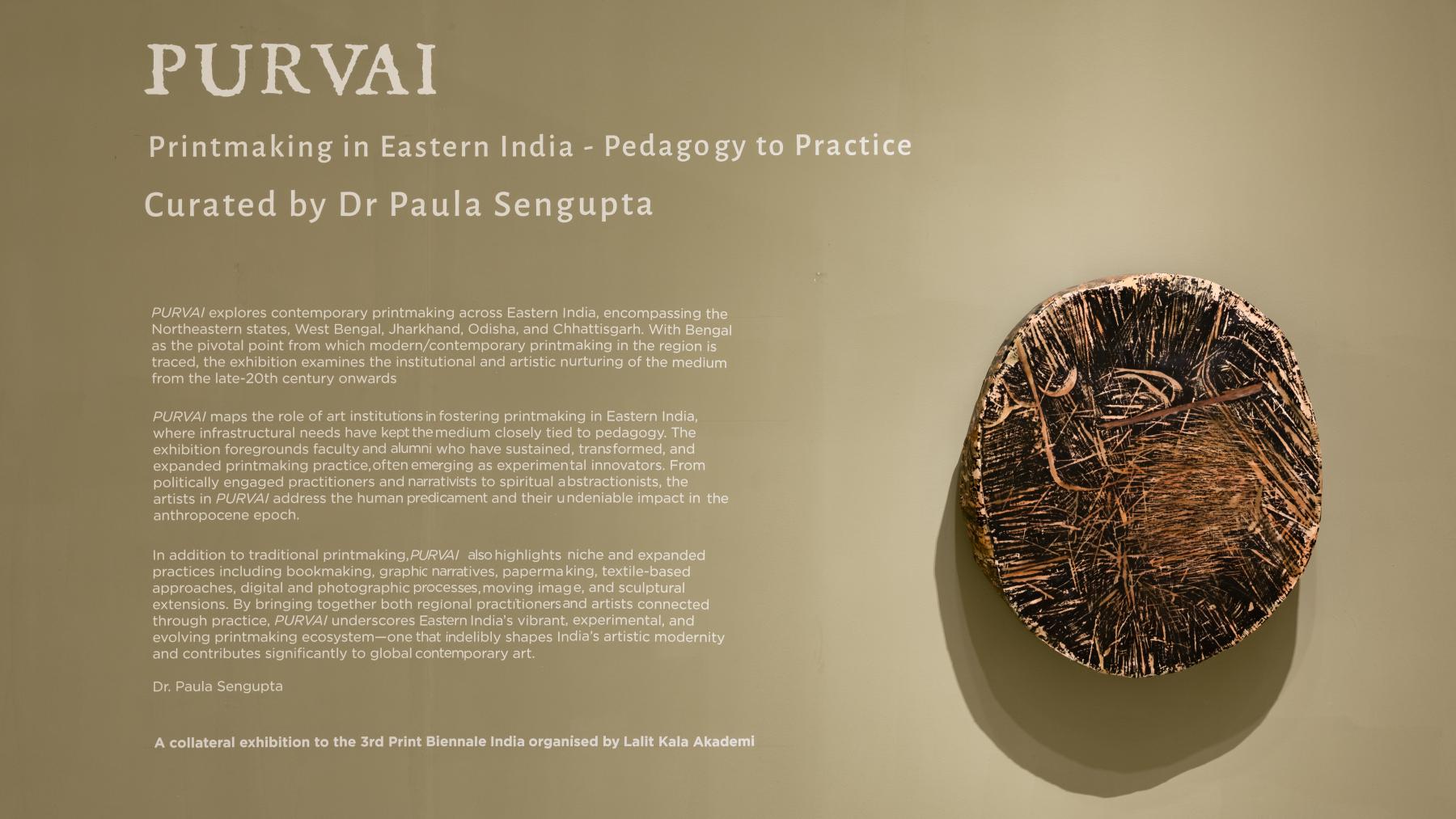
With forty-three artists spread across a majority of the generous ground floor space of Emami Art, Temsuyanger Longkumer’s “Portrait of a Chopping Block” (2025) first came into view as a massive block of wood installed on the wall. On a closer look, it shapeshifted into a built structure imprinted with the deep slashes from an aging and used chopping block. Longkumer’s rendition of the portrait thus becomes girthy and heavy in carrying the surface record of an object’s past and present continuous life after its severance from living ecology.
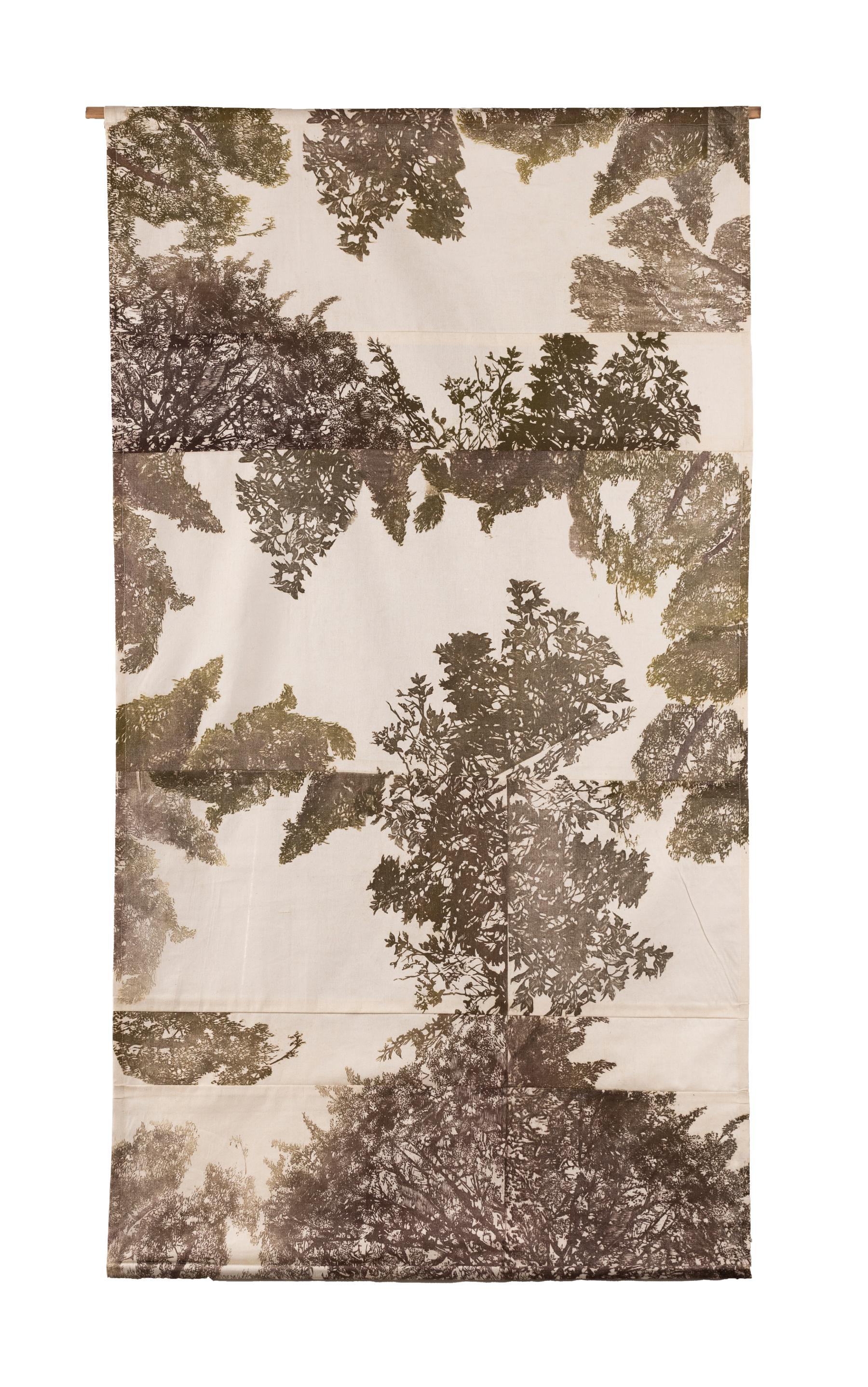
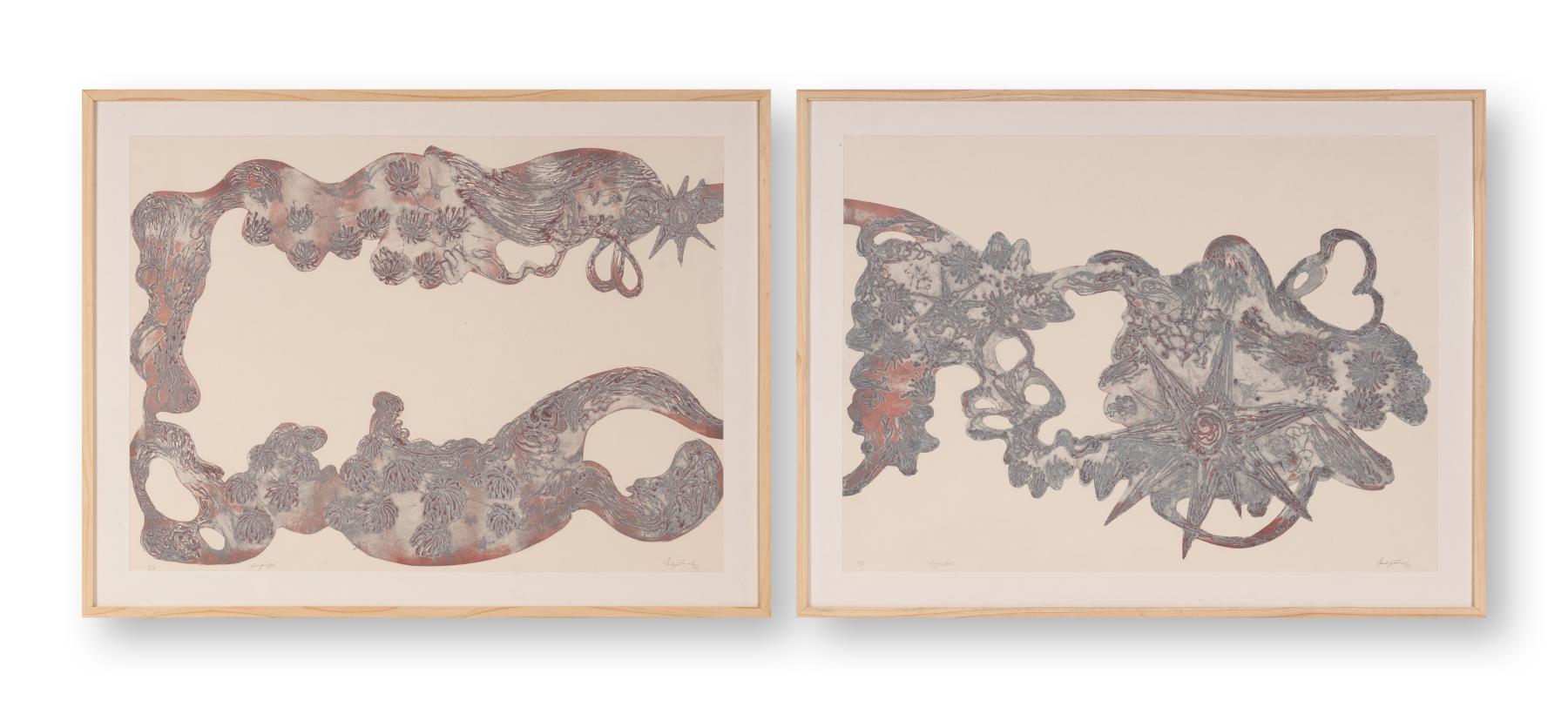
In contrast, Sarika Goswami generates a telescopic view of something alive; from the ground, she presents her woodblock prints of the heads of tall canopies as seen from below, making one feel like a fish peeking out of water, gazing at the vegetation-dotted sky above. This perspective is an unsolved puzzle on textile where mismatched views collide in a psychedelic view like a rotating kaleidoscope. Shaping dream states are Aadya Kumari’s loopy and amorphous organisms with rhizomatic interconnected bundles of nerves bursting forth like active dream phases, pulsating faintly within the red light of impending hyperawareness—all the while shining silver in her colograph.
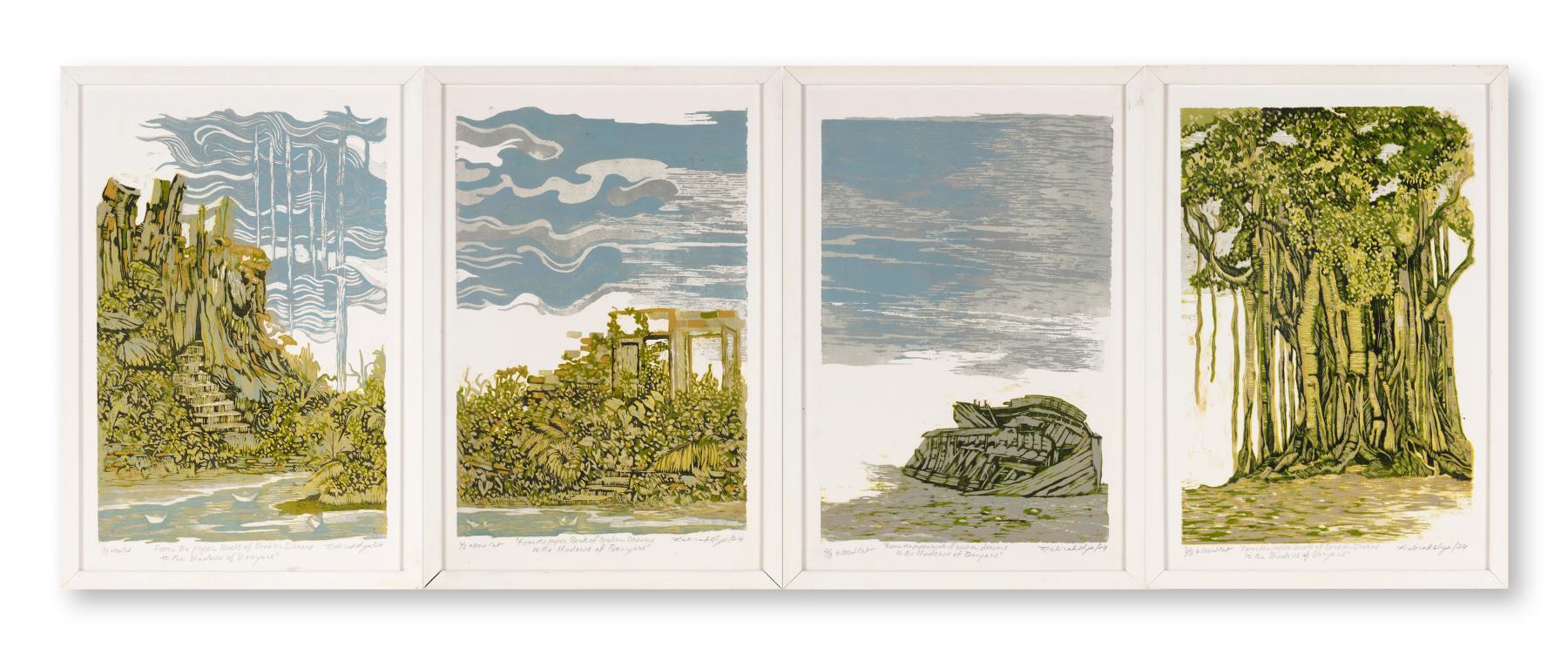
A few works away, Nalinakshya Talukdar’s fluid skies swirled in his graphic woodcuts—likely part of his book illustrations for Voices in the Wind: Folktales, Folklore and Spirit Stories from the Himalayas (2026)—flowing like panels in a graphic narrative awaiting the accompanying text. Blue-grey clouds, menacing in their beauty, are almost held at bay with the enduring green of the vegetation below that holds onto the ground that houses crumbling living spaces. Nearby, Chandan Bez Baruah printed a riverside view in the northeast through highly adept dots making up the woodcut, giving the luminous illusion of amateur festive lighting during festivals in Bengal—evoking the sheen of printmaker Haren Das’ woodcut capturing the movement of a river during sundown, its ripples burnished bright. The other work in the exhibition that followed this technique was Amiya Ranjan Ojha’s etching out of a mosquito net on wood. Here, the close-cropped dots emulate the white noise of television static—akin to the buzzing of the mosquitoes and restless sleep within the repelling instrument which is suspended in mid-air, enveloping four tired students, transforming a storage unit to a bunk bed sans bedding.
Sengupta propelled us to deliberately pause between meandering throughout the expansive exhibition with a series of books. This included issues published independently by Tripura-based zine and comics collective, Cross Cat Collective, of their annual comic Psychera and a haunting cyanotype and serigraphy. Quite intriguing was an artist's book by Soumyabrata Kundu which slices up the body through a stinging monologue of the anxiety of not being perceived. This is delivered in a tongue-in-cheek manner through X-rays, which attempt to maintain a semblance of normalcy through outer clothing stitched over their very body as shirt-buttons on the ribcage or shoelaces piercing through the feet.
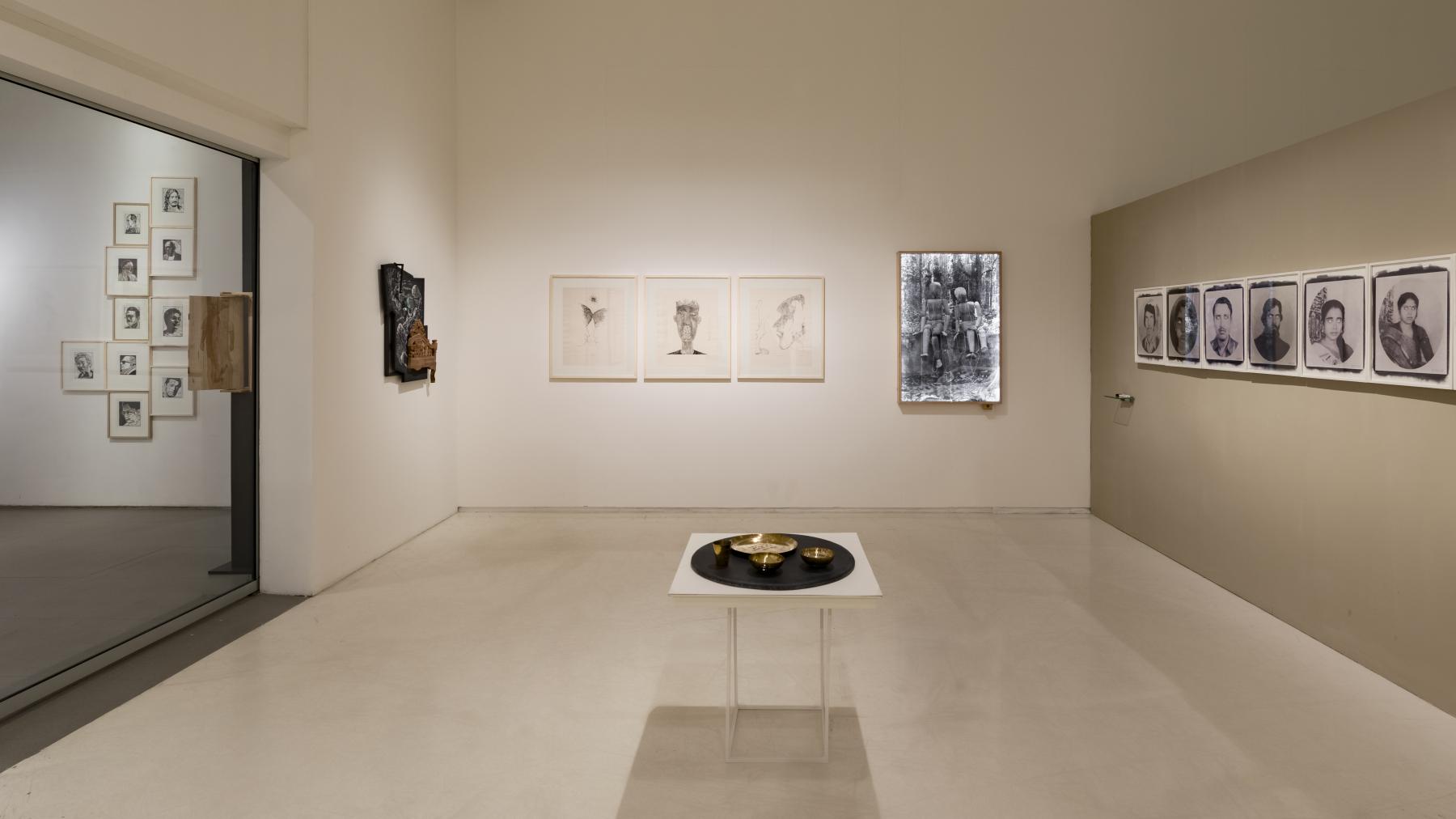
Kundu’s self-deprecating humour played on multiple levels and was something one encountered again as carved-out hollow lettering on a set of brassware that encouraged gouging in prosody, turning on their head the familiar cautionary Bengali idioms against the very act. Kundu’s utensils are etched with a cornucopia of fries and fritters of brinjals, bottle gourds and the staple rice-lemon-chillies combination along with tomatoes—exceptionally with two bowls of prawns and ilish (hilsa), an unusual combination of aquatic gluttony—sans the meat. The engravings emulate etched copper plates in twentieth-century Bengali homes or even recall the superstitiously frowned upon act of drawing and writing upon one’s plates with leftovers.
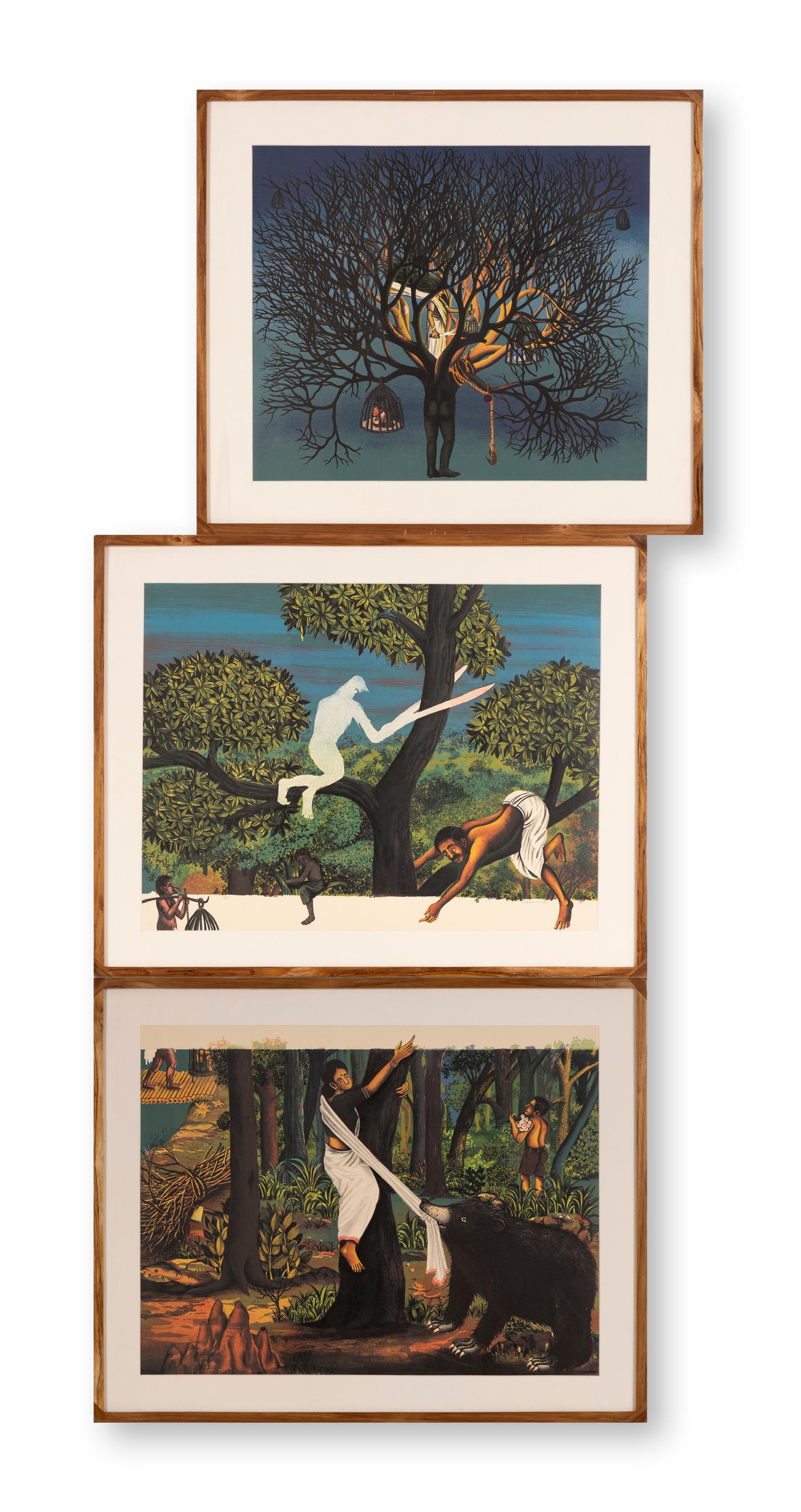
Childhood stories of phantoms like the brohmodoito (a Brahmin ghost) in Bengali fairytales come to life in Subrat Kumar Behera’s lithographic series “The Cursed Tree” (2022). In the work, spirits capture hapless souls wandering near their tree in the dark—its striking visuality of humans caught in hanging cages on bare tree branches cannot help but bring to the fore the imagery of farmer suicides in recent times. This transforms into an invisible phantom sawing off a tree and about to wreak havoc on a man seated atop the tree, bringing to mind the story of Kalidas, who attempted to cut the very tree he was sitting on. It forms a diptych with an astomatous woman plagued by a bear, extending her hand for help towards the man, as a mischievous spirit—who has just caged a human—looks on.
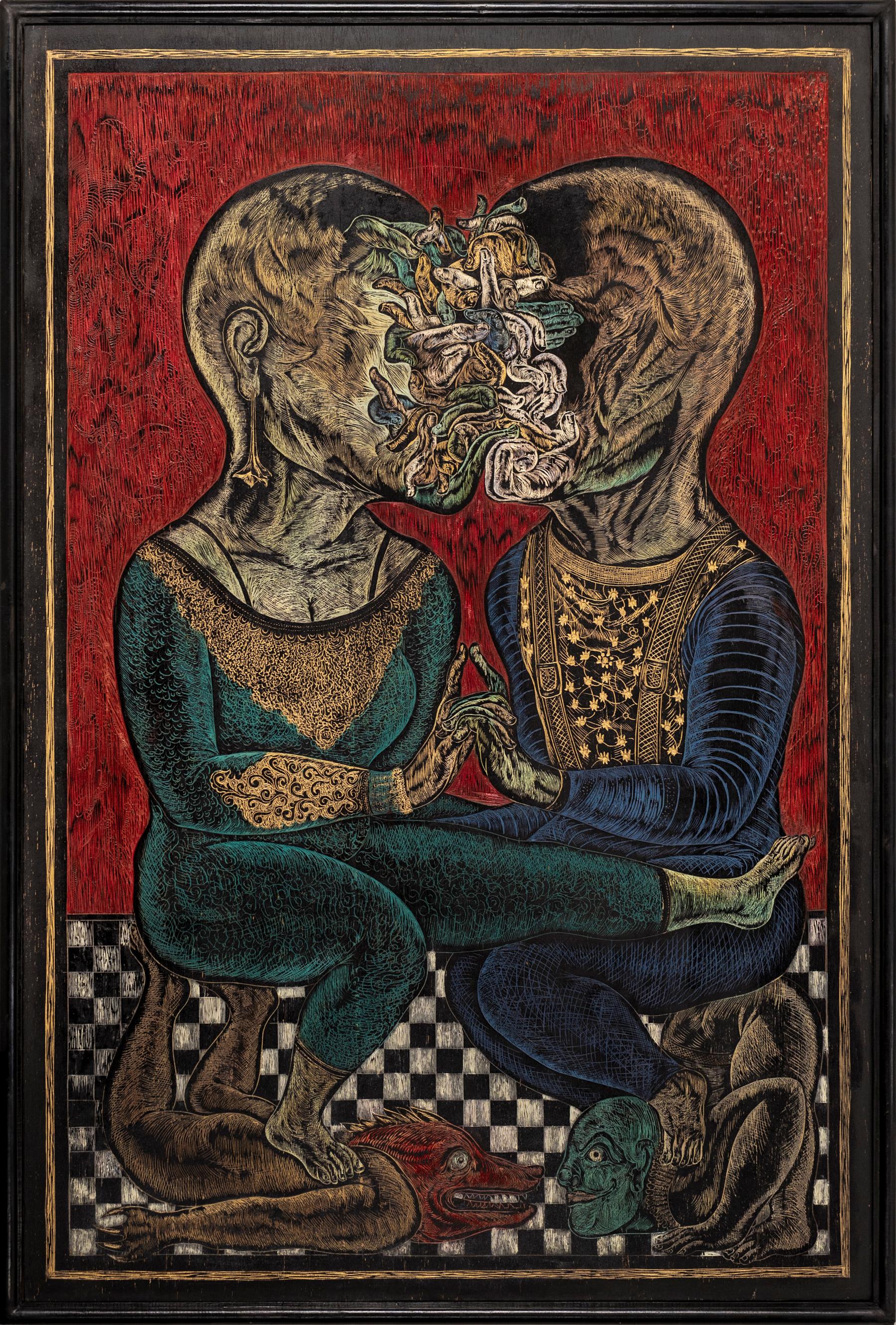
The anthropomorphic returned on a much larger scale, through the largest work in the exhibition, which was made using letterpress ink on a woodblock panel by senior artist Srikanta Paul. Here, two monumental figures sit atop their chosen anthropomorphic beasts of burden on a chessboard, as they claw open the other’s visage. The darker red and green palette was reminiscent of Bengal artist Rabin Mondal, whose acrylic and oil renditions of a seven-armed Kali in thick brushstrokes can be recalled in Raj Kumar Mazinder’s wide linocut strokes in “Mother Goddess" (2025). Belonging to the generation after Mondal, Mazinder's deep lines render his lino plate sculptural, emulating expressive brushstrokes. "Mother Goddess" was a culmination of his research on Durga images at various archaeological sites, the exhibition note said, and draws from resources of ethnic communities who have celebrated this figurehead and often evoked figures like Kali in underground rebellion. The exhibition delved further into the practices and preoccupations of such senior pedagogues in the subsequent segment, which will be explored in the second part of this essay.
To learn more about printmaking, read Adreeta Chakraborty’s conversation with Anupam Sud and Aparna Chivukula’s conversation with Jayeeta Chatterjee.
All images are courtesy of the respective artists and Emami Art.