
Relooking at Krishna Reddy: Of Friendships Spilling into Practice
.png)
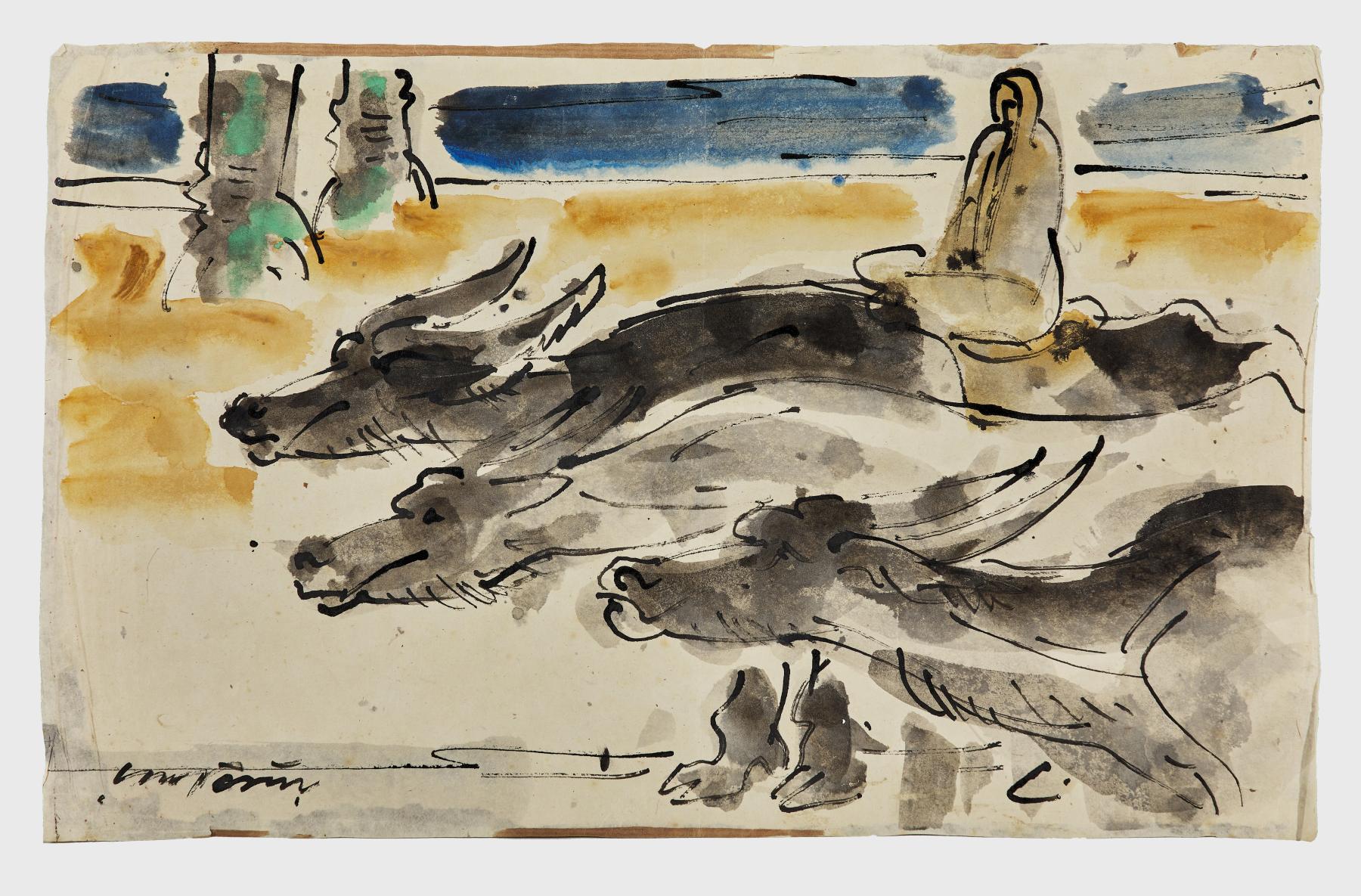
Right: ”Untitled.” (Benode Behari Mukherjee. 1943. Ink and brush on paper, 29 x 23 centimetres.)
“I felt very humble when he (Krishna Reddy) said, ‘let’s exchange a print,’” recalled Zarina Hashmi at the lecture associated with the group exhibition Workshop and Legacy: Stanley William Hayter, Krishna Reddy and Zarina Hashmi at the Metropolitan Museum of Art, New York in 2016. “It is different when one lives with a work of art and sees it day and night,” she added. This was also a familiar experience for Reddy, who filled up his studio with works of his friends and mentors like Benode Behari Mukherjee from Kala Bhavana in Santiniketan as well as colleagues including Zarina, whom he would later meet at Stanley Hayter’s Atelier 17 in Paris.
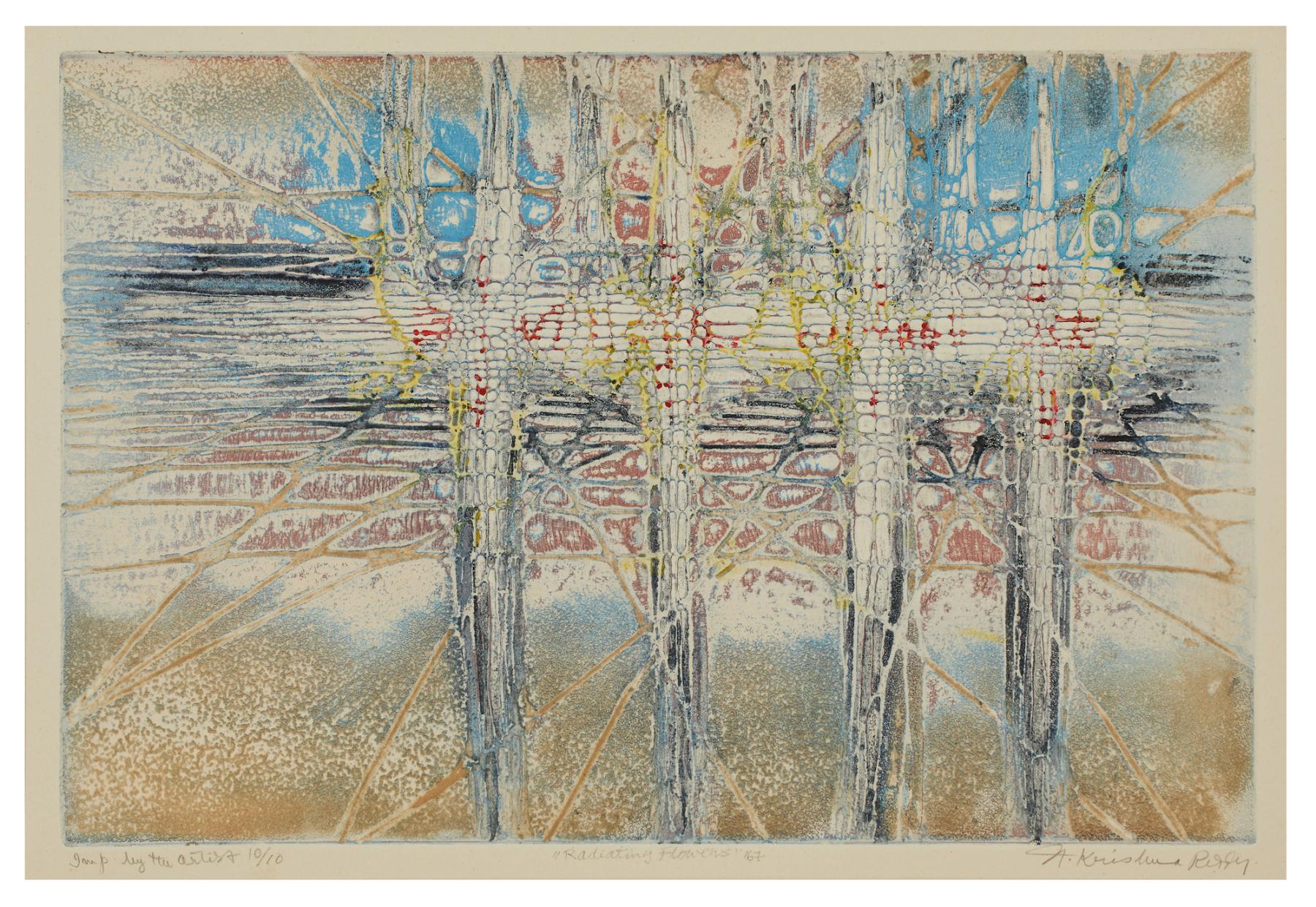
These works of affection, pulsating all over his New York studio like live wires of his rhizomatic creative networks, have been acquired and brought back to his familiar grounds of Santiniketan by Experimenter as part of their centennial exhibition on the artist. Krishna Reddy at 100: Of Friendships was held from 6 December 2025 to 21 March 2026 at Tokaroun in collaboration with the Musui Art Foundation. An iteration of the exhibition was showcased at Experimenter’s Colaba and Ballygunge Place galleries earlier in 2024. Placing works by his friends and collaborators in conversation with his practice, it created a space for them to speak to each other visually and through technique. For instance, fiery flowers rendered in watery blotches of colour gathered at one end of Mukherjee’s quick yet deliberate brushstrokes were juxtaposed with a riverine refraction entitled “Radiating Flowers” (1967). Conjoined and segregated at the same time, the latter was rendered by Reddy using his pioneering printmaking technique of viscosity.
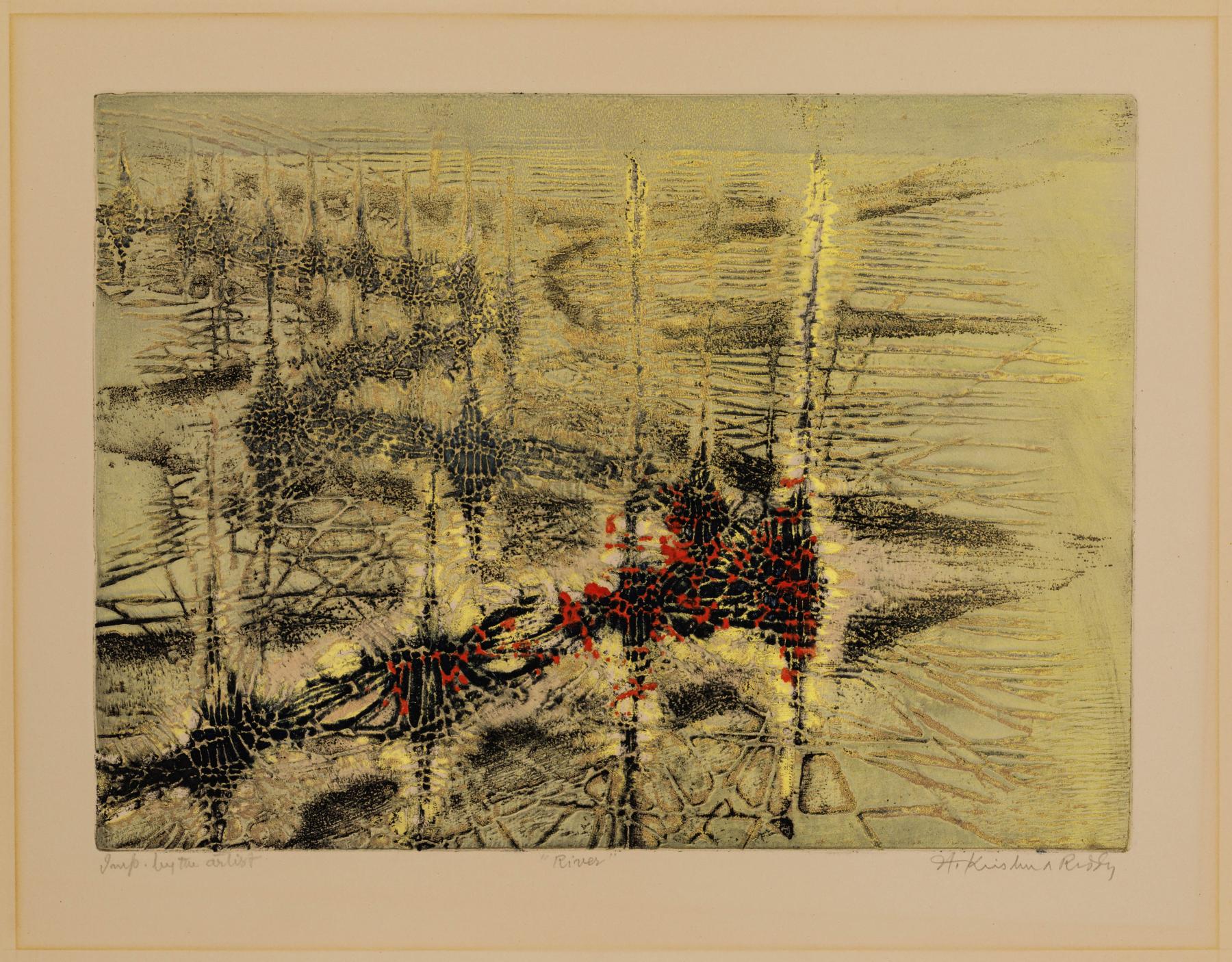
It somehow replicates the feeling of being submerged right below the surface of a river and staring closely at the entangled roots of flowers and aquatic life which bloom on the surface, while also looking at the sun-spangled water rippling its way into miniscule patterns ebbing away in the distance. Freezing and unfreezing simultaneously, it propels us to listen to their “invisible and microscopic moment(s),” as curator Sarah Burney wrote in her catalogue essay for the exhibition, Krishna Reddy: Heaven in a Wildflower (2025), held at the Print Center in New York last year. She notes:
"When he considered a fish, he wondered at how many bundles of cells ‘come together, shape themselves into many forms like bones, muscles and fins to navigate and live in the abundance of water.’ He concluded, ‘I had a feeling that space itself is creating the fish.’”
It is the endless “doubling” of such living cells constituting an organism that fascinated Reddy—a persuasion he would transform into image form. In “Life Movement” (1972), mutating gossamer organisms like nerve endings breathlessly await a moment of being scorched in the iridescence of an electric dusk.
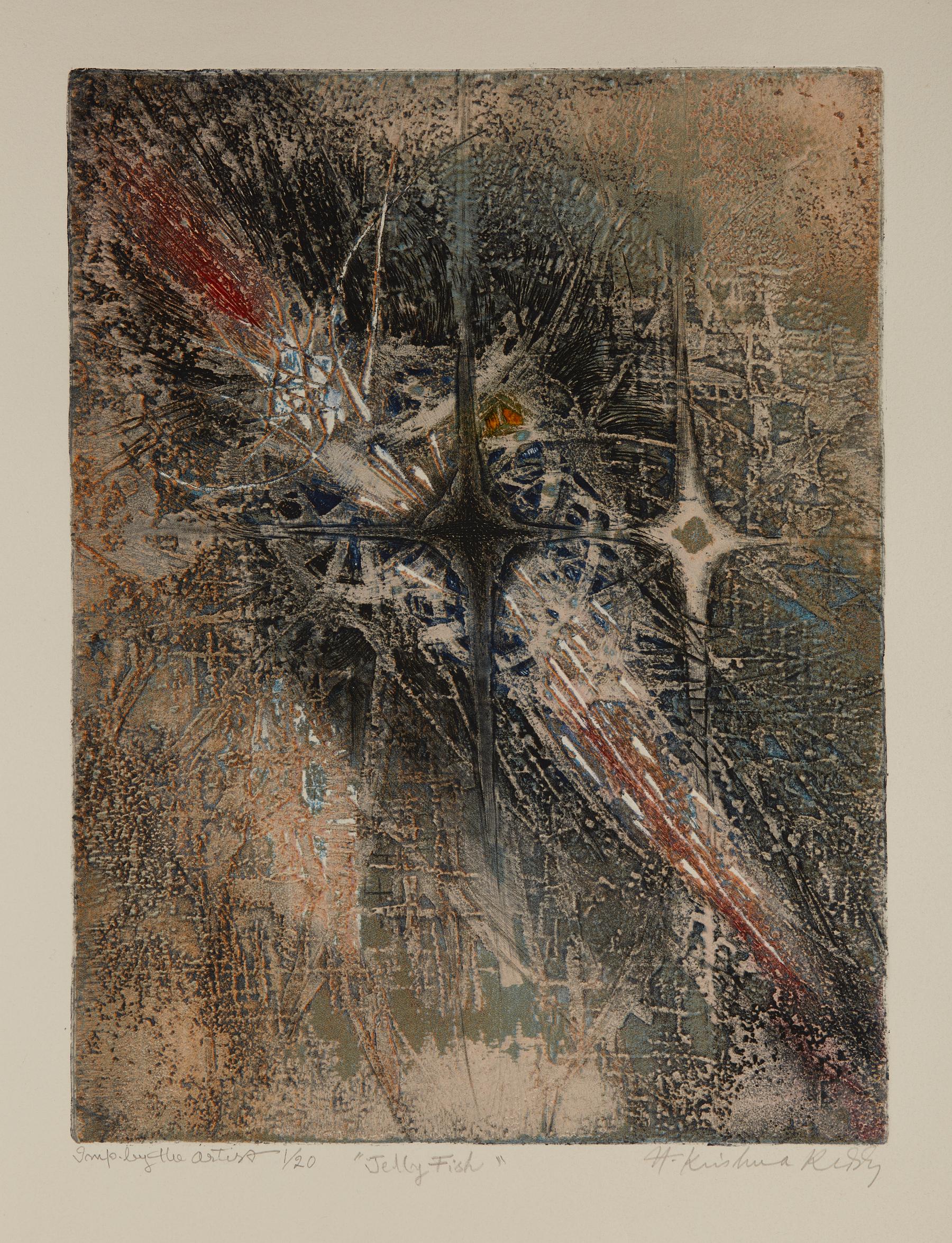
Reddy would recall how the modernist artist Nandalal Bose—then principal of Kala Bhavana—watched him struggle to depict a tree and cryptically pointed him to move beyond the surface level of illustration towards an understanding of essence. It is a monumental experience to encounter Reddy’s work beyond published prints in small scale and to observe how he infuses movement within stillness through linearity and colour—almost like a colourist. This is particularly visible in “Jelly Fish” (1955) where an aquatic being flits through water like a rocket or an imperceptible transmission, leaving behind a trail of red and pockets of yellow along with a violent, frothy spray in its wake, whose form Reddy abstracts into geometric shapes, which will soon settle, undisturbed. However, it is the charged moment of disruption and refraction that matters for Reddy—as he ascertains a vanishing presence.
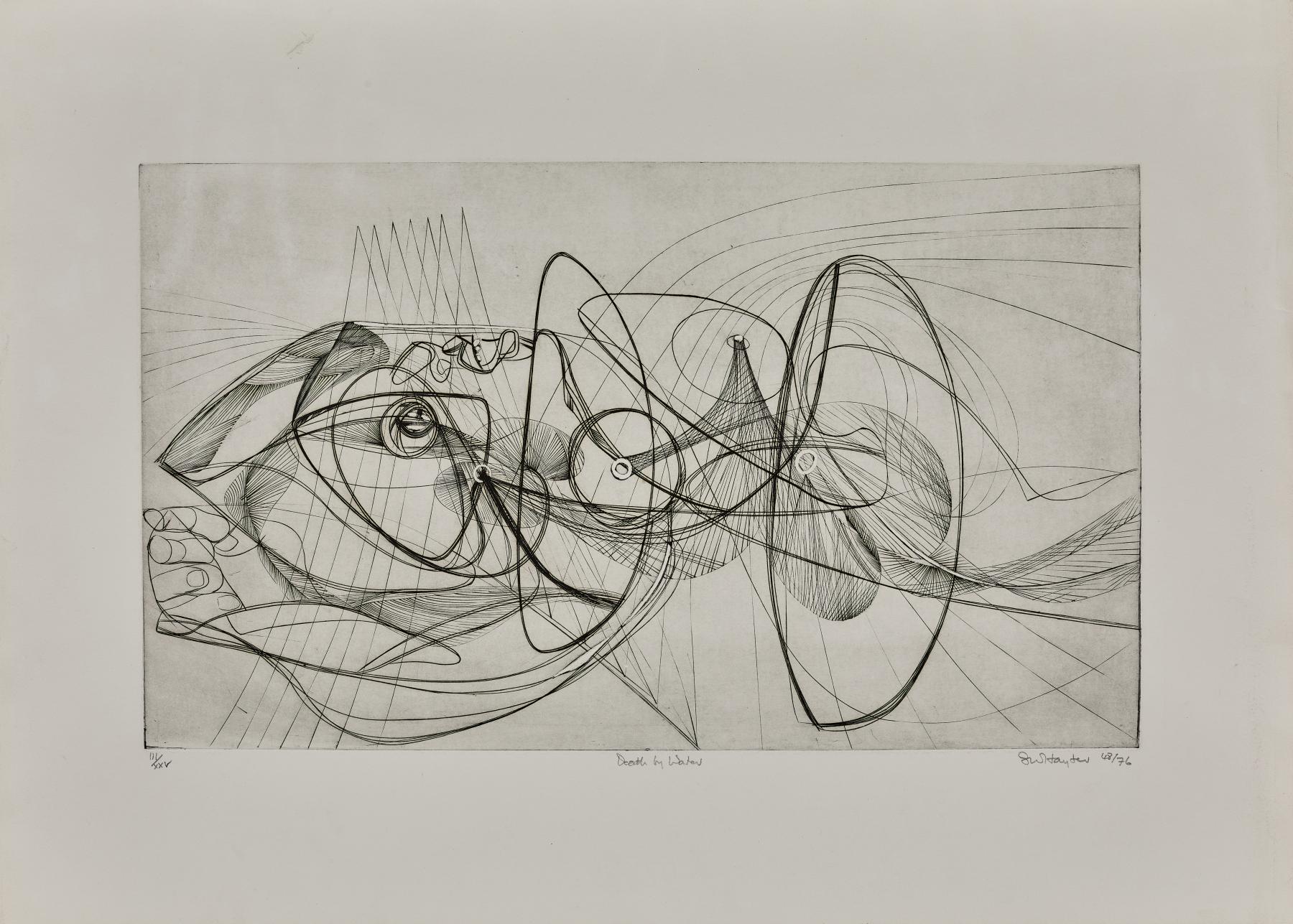
Hayter was also exploring fluidity and motion—particularly through the free-flowing line, drawing from the preoccupations of surrealists around him. It is apt that Reddy’s figurative works in ink or more elaborate etchings were displayed in conjunction with Hayter’s “Death by Water” (1948), where lines entangle and merge only to unravel again—like the visuality of sonic tempo or a stream of consciousness projecting associated images as it ambles along.
2.png)
Right: “Musician.” (Krishna Reddy. 1953. Etching with aquatint on paper, 30.5 x 20.8 centimetres.)
In other etchings such as “Cityscape” (1950), Reddy seems to follow the proliferation of polyphonic lines, much like his teacher Ramkinkar Baij, whose work was also on display at the exhibition, including an untitled etching depicting the dark and menacing cityscape looming before a solitary traveller. Reddy seems to be structuring the lines in etchings like “Cityscape,” where, similar to his viscosity practice, he divides the page into segments—as two figures appear to be caught in their own precarious bubble while uniform buildings undulate in perspective beyond.
The artist’s preoccupation with the line surfaces strongly in “Untitled (Seated Figure)” (1951), which he possibly created after becoming acquainted with Hayter. Limbs and bodies collapse onto each other, with the line rendering a precarious sense of order and planned choreography, missing in another early work, “Reclining Figure” (1950). This dynamism develops further in his aquatint etching, “The Musician” (1953), made deep into his collaboration with Hayter, where he tilts the player’s body and encircles him with a line to heighten a sense of movement.
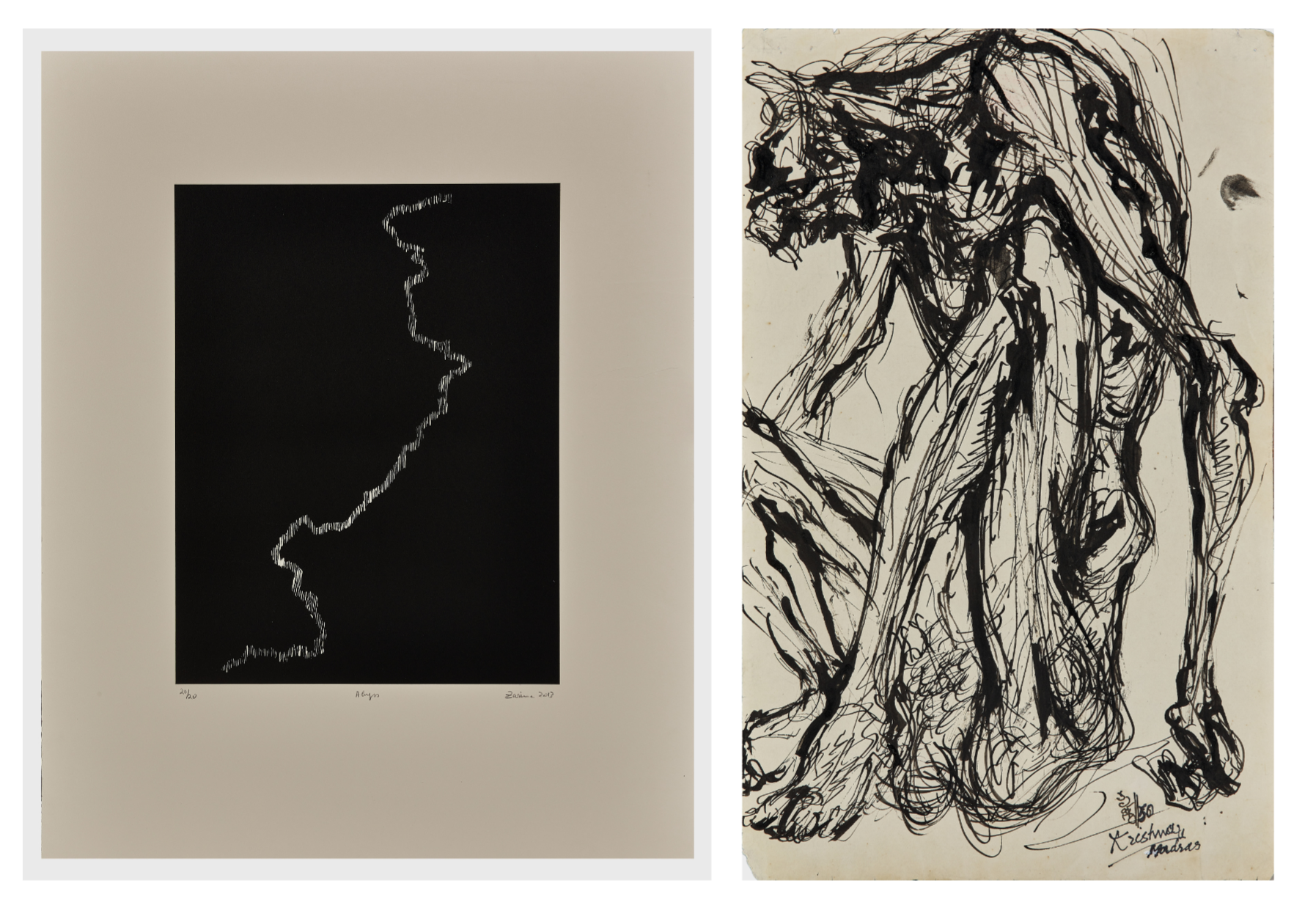
Right: “Untitled (Bengal Famine).” (Krishna Reddy. 1950. Ink on paper, 33.8 x 21.3 centimetres.)
Some of these works in the exhibition are placed alongside Zarina’s “Abyss” (2013), where a line akin to a border cuts through the frame—emblematic of the 1947 Partition. Reddy’s figuration takes a different turn in his earlier documentation of the Bengal Famine (1943). Following many Bengal artists of the time, including Chittaprosad Bhattacharya and Zainul Abedin, Reddy started documenting the effects of the famine through the physicality of long, gaunt limbs and emaciated bodies rendered faceless in ink—perhaps it was another way of representing the bodies he would see in Calcutta in “Reclining Figure.”
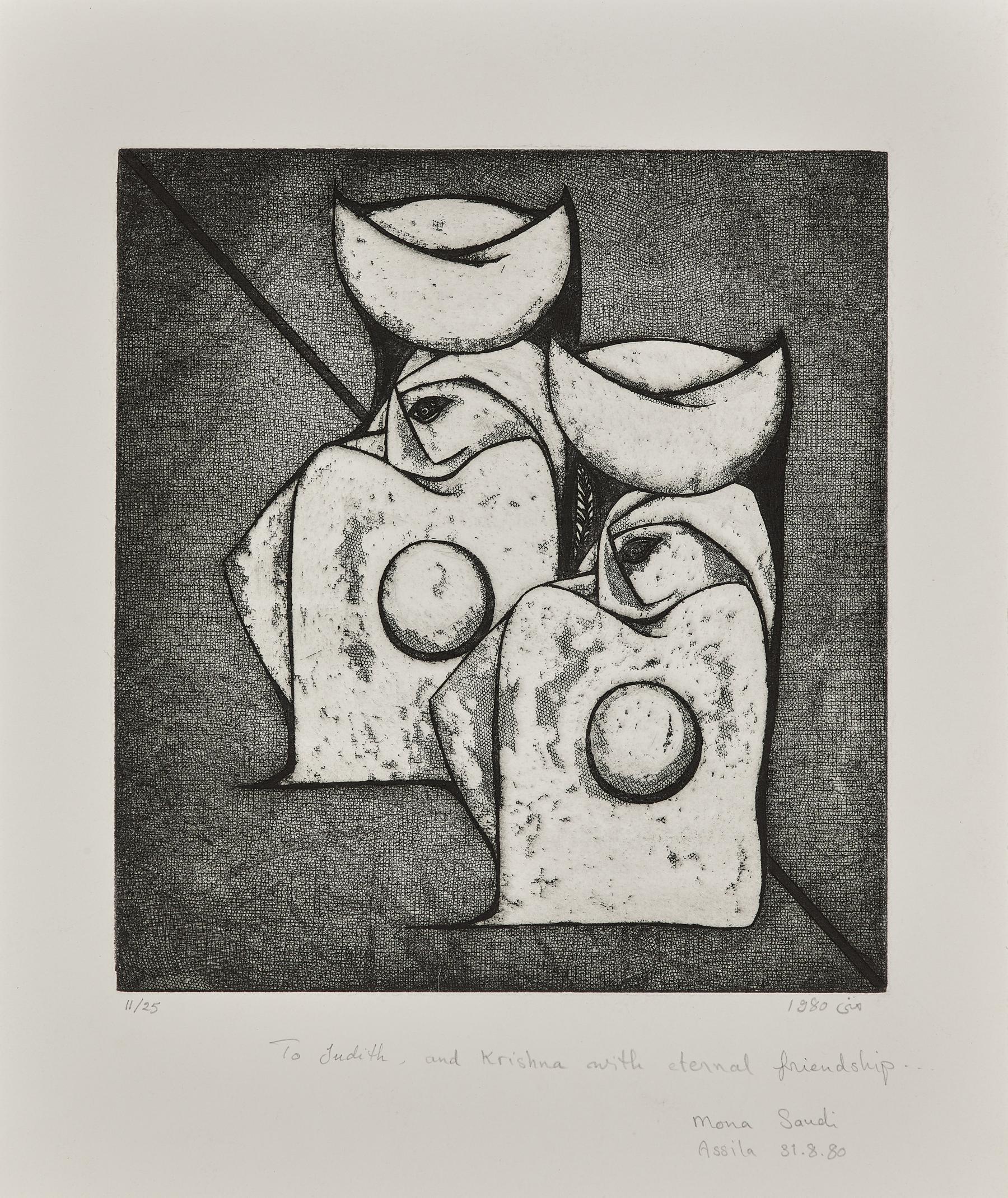
A bronze figure strides forward in the middle of the room, reduced to the pure geometry of its limbs—a clear influence from Alberto Giacometti, whom Reddy befriended during his stay in Europe, and from the fluid lines of his Slade School professor Henry Moore. He also became acquainted with the sculptor Constantin Brancusi, who inspired the sculptures of his Atelier 17 friend, Mona Saudi. This connection becomes prominent in Saudi’s interpretation of figuration in an etching she gave to Reddy, hanging at the exhibition.
Paris was a sculptural environment for Reddy, he said in his NDTV and BBC documentary, as is evident in his viscosity plates. He meticulously etched deep and intricate incisions into zinc plates—interspersed throughout the exhibition—which he intended to treat as signifiers of process and finished sculptures in themselves, through which one can observe an image coming into being like a photo negative. Now, they stand wiped clean of ages of colour within their ridges.
.png)
Right: ”Ripple.” (Stanley William Hayter. 1970. Multicolour viscosity print on paper, 56 x 75.5 centimetres.)
A lot of Hayter’s work in Atelier 17—which was devised as a workshop for experimentation—was done in collaboration. That was how he developed viscosity along with Reddy and Kaiko Moti. They would stay back in the workshop every Sunday to experiment with how a drop of raw linseed oil transformed the viscosity of inks and altered the way they interacted with each other. Hayter was already using simultaneous colour printing methods by using stencils to transfer colours onto an engraved plate where “the colours would be slightly off” even as the print emerged in one pass through the printing press—as one would see in his work “Cinq Personnages” (1946). However, understanding viscosity meant sculpting a plate with varying depths. This would be filled with inks that repelled and merged with each other—depending on their viscosity—by rollers of varying densities that either covered the surface or went deep into the grooves of the plate.
Hayter’s plates were simpler compared to Reddy’s, the line still coming through strongly in his viscosity works. Yet some followed Reddy through the predominance of water, like in “Ripple” (1970) which seems to abstract sunlight hitting a sparkling clear river in the morning, rippling in golden hues.
.png)
Right: ”Untitled.” (Gabor Peterdi. 1962. Etching on paper, 38 x 50 centimetres.)
A viscosity work entitled “Crystal” (1960) by Shirley Witebsky—Reddy’s first partner, whom he met at the Atelier—seems to contain and hold captive, compared to Reddy’s style, which flows and follows the movement of waves and fluid matter.
Another printmaker from the Atelier, Gabor Peterdi’s intricate etching of barren branches jutting out like barbed wire in a desolate land, emblematic of postwar Europe, hangs near Reddy’s early Ajanta sketches made during his Kala Bhavana days.
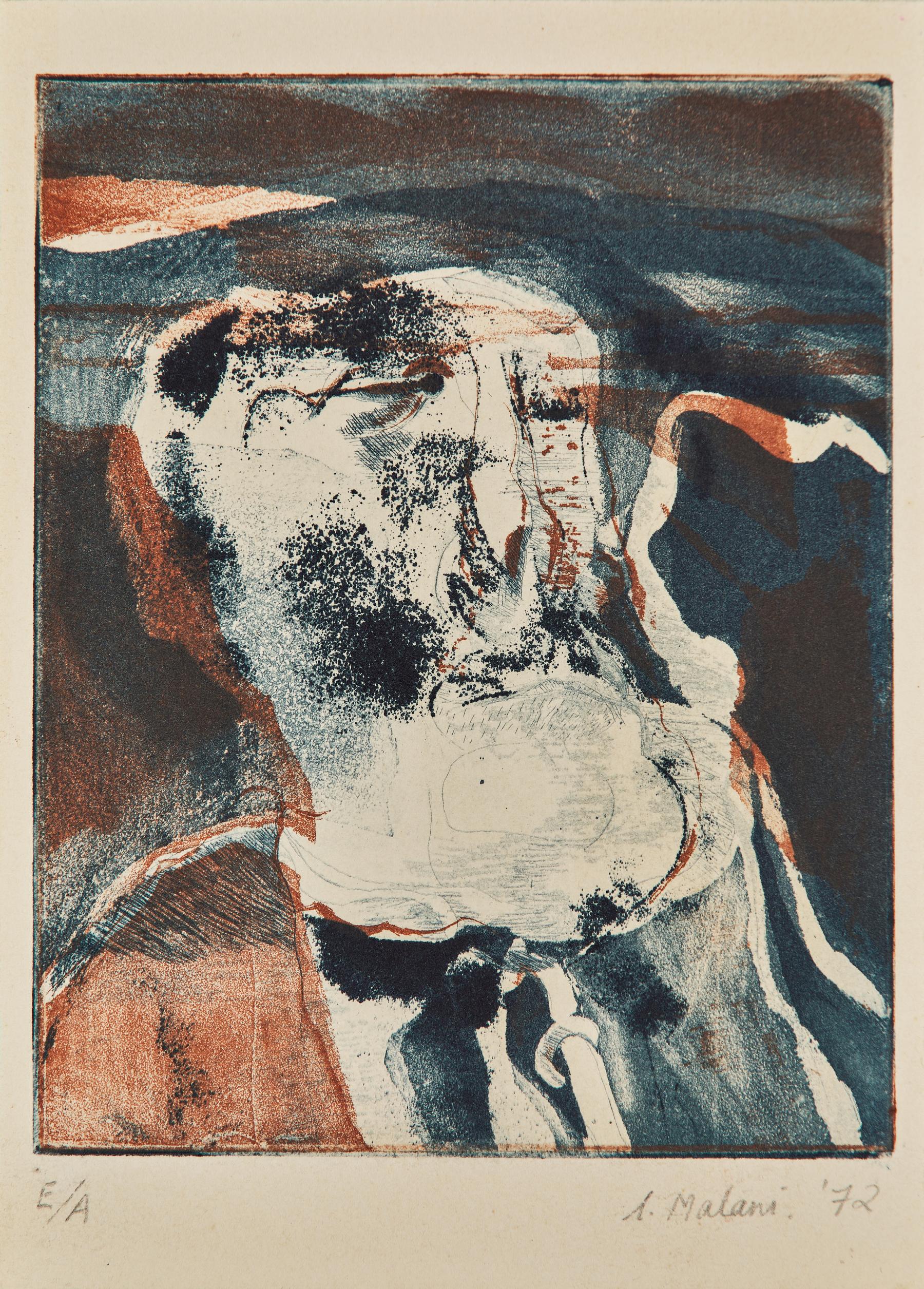
Perhaps the only surprising presence in the exhibition was a viscosity print by Nalini Malani, with whom Reddy seems to have been in correspondence. Rendered quite differently in style than any of the other viscosity works in the exhibition, Malani’s work signifies what Reddy always believed—that technique came secondary to the desire to discover. As his student Mark Johnson would recall Reddy’s words in the catalogue for the Print Center exhibition: “We do not know and we want to find out.”
To learn more about printmakers in India, read Upasana Das’ two part essay on the collateral exhibition curated by Paula Sengupta for the third Print Biennale in India, Radhika Saraf’s two-part essay on Arpan Mukherjee’s solo exhibition Impermanence (2025) as well as Anisha Baid’s curated album from the Mukherjee's series Fairer People = Beautiful People = Powerful People (2013–18). Also read Adreeta Chakraborty’s interview with Anupam Sud and Aparna Chivukula’s conversation with Jayeeta Chatterjee, recipients of the Asia Arts Game Changer Awards 2025.
For more insight into artists as friends, revisit reflections by Das on Experimenter’s exhibition, Artists for Artists (2025).
All images are courtesy of the respective artists and Experimenter Gallery.