

Cinematheque Beirut: Thinking Through Archival Praxis
The film programme “Visions of Capture,” curated by the Cinematheque Beirut team, was presented on 25 October 2025 at the Arab Image Foundation as part of the “Violence and Visuality” conference organised by the Media Studies programme at the American University of Beirut (AUB). After the screening, Mariz Kelada and Sara Mourad from AUB Media Studies spoke with Anaïs Farine, research consultant at Cinematheque Beirut, and Karim Naamani, database coordinator at Cinematheque Beirut. The first part of their conversation delineates their process of programming around questions of violence and visuality. In the second part, they discuss more about building a film archive, specifically in relation with histories of violence.
Sara Mourad: Archives and archival practice are also entangled with forms of capture in indexing, categorising, rescuing and restoring. If films serve as visual documentations of violence, the film archive is a repository of violent histories, but also one that may enact its own, distinct forms of violence. Here, I am thinking of what gets lost or left out in the process of archiving. But also of the destruction of archives which amounts to a silencing and erasure of the past, for instance through the plunder of the Palestinian film archive. There are more subtle instances where violence is enacted through use and misuse of visual archives.
As a cinémathèque in Beirut, could you tell us more about your mission and vision as a cultural organisation? What synergies do you have with other cultural organisations working on visual practices and cultures across the region? And beyond the preservation and archiving of films, how do you envision your curatorial role as a form of public practice, a way of situating films within their socio-historical contexts, of making the past speak to audiences in the present?
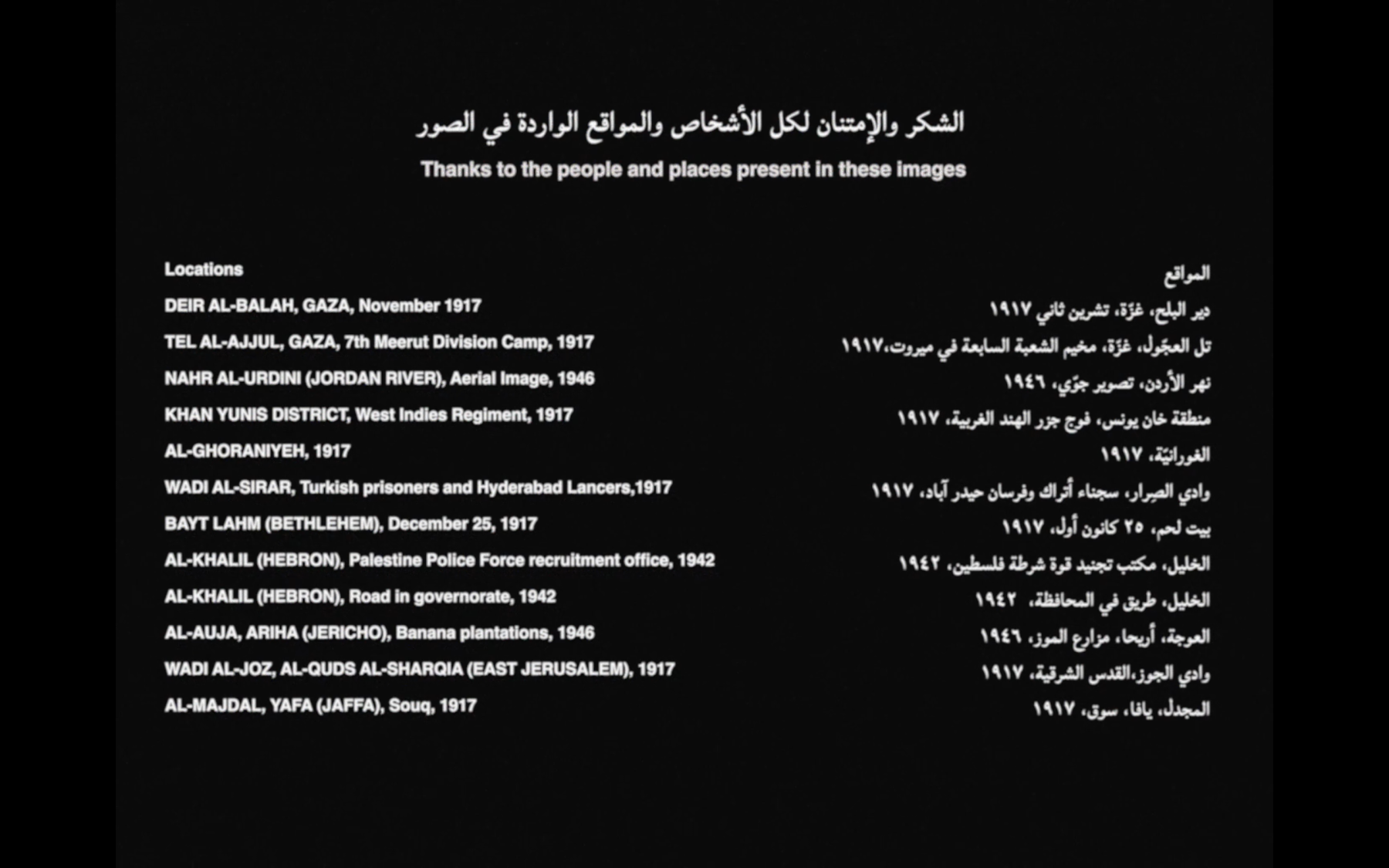
Anaïs Farine: Actually, this question will take me back to the first one. The word “capture” in the title of the event came from my reading of a text by Diana Allan about her last film Partition (2024). Partition is made of archival images shot in Palestine during the first half of the twentieth century that are now kept in the Imperial War Museums (UK). The original films were shot by the British colonisers, some of them in Gaza. In “Not the Songs but the Singing: Sounding Sense in Colonial Films from British Mandate Palestine” (2022), Diana Allan writes: “These films document histories of British imperial dispossession and are themselves a medium of capture.” Besides the fact that this sentence echoes the violence of visuality that was central for both Karim and me when looking for films, Partition also speaks to the “archival violence” that you mentioned. Allan refilmed the archived colonial images in 16mm. At the end of the movie, she credited the names of the cities and villages where the original films were shot but refused to credit the Imperial War Museums. Her practice is a response to the violent act of being kept and indexed by the Imperial War Museums.
About the Cinematheque Beirut, the project was launched in 2018 by the Metropolis Cinema Association and is dedicated to researching, conserving and disseminating heritage and contemporary Lebanese film. Through the creation of tools and content that are accessible to as many people as possible, the project objective is to highlight the rich diversity of this heritage. The Cinematheque Beirut is both an online database and a physical space where we preserve a collection of posters, books, films and the institutional archives of the Metropolis Cinema. I started collaborating occasionally with the Cinematheque after I moved to Beirut in 2019. One of the reasons I was eager to collaborate with the team was the question of accessibility. Since its inception, the project of the Cinematheque has been to make independent Lebanese movies that were screened only a few times during film festivals available for viewing. Currently, our viewing station includes more than 400 films that can be watched for free. At the Cinematheque, when we digitise film journals, or when we add films to the viewing station, the purpose is to preserve them, of course, but it is also and first of all to make these resources accessible to students and cinephiles.
I also want to mention an interesting paradox. None of us are trained as an archivist. I am a film historian and I now work at the Cinematheque. This can be an obstacle, because we need training to create standardised metadata and cataloguing that would give more visibility to the resources that we are collecting, preserving and digitising. But this obstacle has two “positive” sides: first, we were not trained to follow the international system of classification. I remember attending a panel of the Archives & Heritage for Palestine series last year during which the need to create a new system of classification for decolonisation purposes was mentioned. For us, as we look for training in this field, we do not need to unlearn this. Another important aspect is that the lack of regular training in film archiving in Lebanon creates a constant dialogue between our organisations. For example, the Arab Image Foundation is currently supporting us by sharing their expertise so the Cinematheque Beirut can create an inventory and preserve the photographic archives of filmmaker Georges Nasser.
Still from Partition. (Diana Allan. 2024. Image courtesy of the artist.)
Karim Naamani: For us, at the Cinematheque, the question of the archive matters in how to think of the archive beyond just preservation. There is the necessity to preserve but it comes down to how we actually think about archives as an ontological, epistemological praxis in forming new modes of seeing and understanding. However, I would also make the point that archiving and archives themselves are ecological. I will even add that it is a cosmo-ecological practice; there is always an archive that precedes us and how that archive finds its way into our daily lives—it obligates us to act. I am taking this idea from another philosopher, Vinciane Despret, who writes about the cosmo-ecology of sheep and their relationship to shepherds. The general idea is that “whenever a being raises the problem of the condition of its existence, it lies within ecological approaches,” and it becomes cosmo-ecological in that other beings will bear the consequences of the attention we give them. Where I am going here is I am really trying to animate archives, it is a little difficult to place where “being” should go, but the way that I see it, it is really about care, respect and obligation. Managing an archive already has its own intersubjectivity in the same way we have with artworks, and I think I will maybe leave it here for food for thought.
On the other hand, I shall also talk about the process we have at the Cinematheque. As Anaïs mentioned, we do not have formal training in archiving practice. I am an artist, and I have done some other archiving work, but the bulk of that work comes down to a digital archive. And exactly as Anaïs said, this lack of formal training means that we can avoid the rigidity of classifications. It allows us to be able to make our own systems that we feel could work better for us. In terms of the database, I think of it as a generally exhaustive site of information on Lebanese films and also films produced in Lebanon. There are around 2000 films on our database and it is constantly being updated. In its own right, it is an archive of information that is readily available to use and work with. To think of the database as an archive is to recognise the materiality of the information on there and how it creates contingencies.
On that note, I want to touch on one more thing relating back to programming. Or maybe on what we did not programme actually, which was short films on archival practice and violence, specifically in the context of Palestinian archives and identity, the capability of Palestinians owning their archives and the narratives of their own lives beyond what is being told by the Israeli apparatus and imperial authorities. We were thinking of another film by Oraib Toukan titled When Things Occur (2016), Elia Suleiman’s Homage by Assassination (1992) and Yazan Khalili’s All the Images Looked Real (2019), and I think all of those films speak to each other very clearly in a really beautiful way. Khalili’s video resonates with me because there is this part where he remarks on the images that he possesses that he scans and places on a hard drive; he points towards the scanner itself and notes “the disappearance of a mortal archive is not catastrophic,” so they scanned the archive and photographs. We can say it exists digitally, yes, but also virtually; it will return back to us, the catastrophe does not matter, we are not afraid of it. It is more than reproducibility and finding a life raft in the middle of the ocean, you know? It is a delicate relationship with the image and the archive and its history that I think manoeuvres around archive fever.
In case you missed the first part of the conversation, read it here.
To learn more about practices of archiving as forms of resistance that take into account various kinds of violence, read Mallika Visvanathan’s conversation with yasmine eid-sabbagh on consciously thinking about the use of language in archiving, Najrin Islam’s conversation with Mariam Ghani on the precarity of archives and Anoushka Antonnette Mathews’ essay on Abdel Salam Shehada’s Ila Aby (2008).