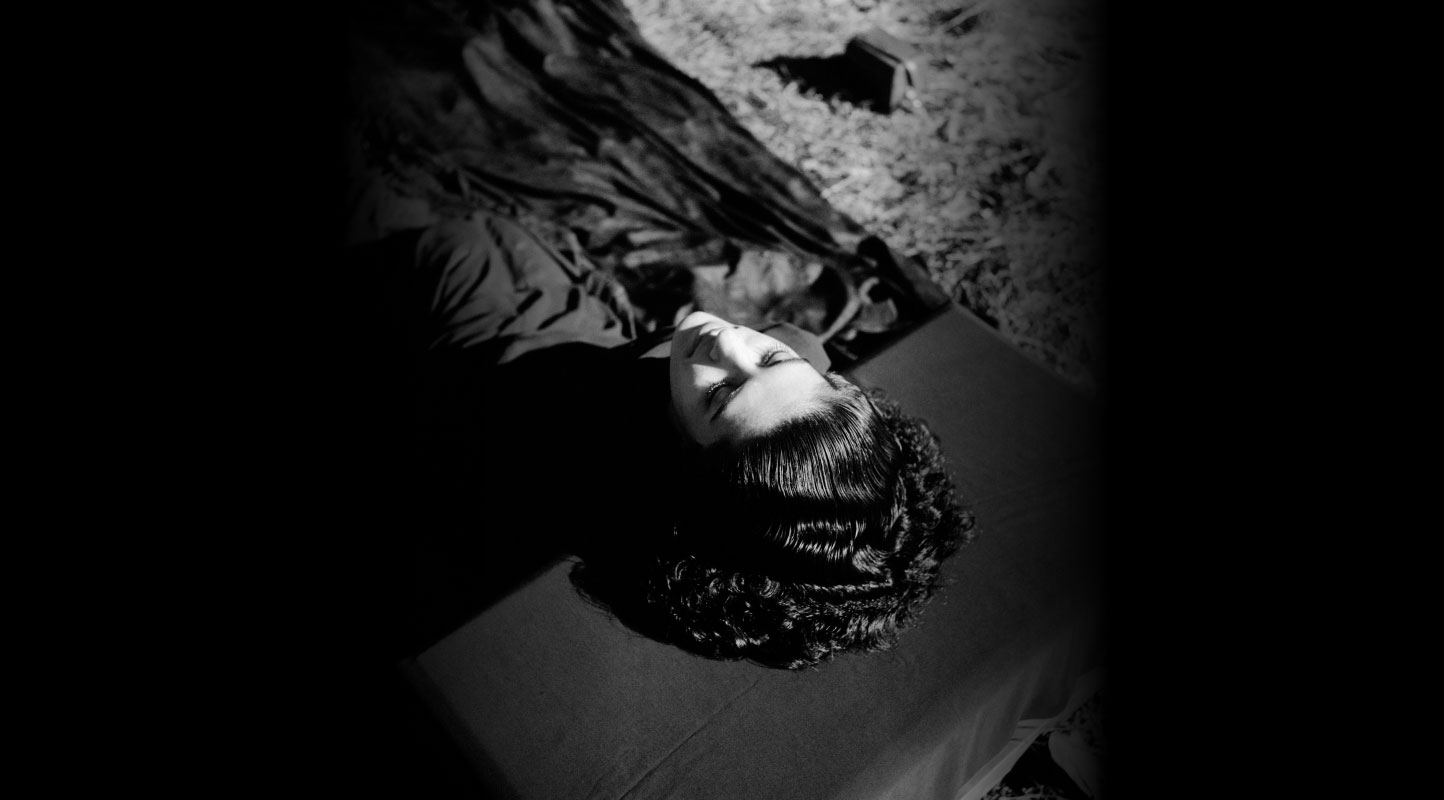


The Idea of Home: On Marjane Satrapi and Persepolis
On 4 June 2026, fifty-six-year-old Marjane Satrapi died in Paris. The city she died in was not the one she was from. This is the subject of everything she ever created.
Persepolis—first a graphic novel (2000–03), then an animated film (2007) that she co-directed with Vincent Paronnaud—is the story of a girl growing up during the Islamic Revolution in Iran and the Iran-Iraq War of the 1980s, one of the longest and most devastating wars of the twentieth century. The novel is drawn almost entirely in black and white: stark, flat, almost childlike in its lines. This was partly a stylistic choice and—as Satrapi once admitted in an interview—partly because she simply could not draw better at the time and decided to make a virtue of it. That kind of honesty was characteristic of her.
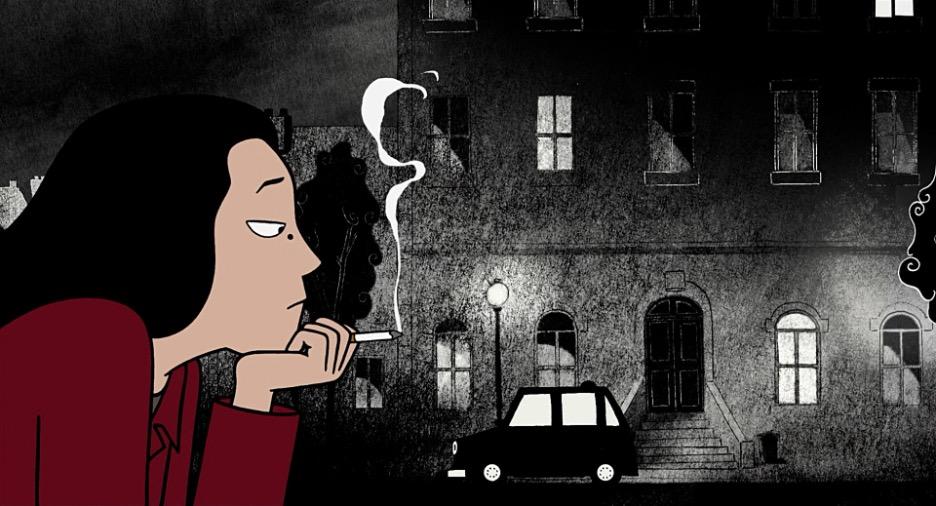
The autobiographical film follows young Marji—Satrapi's fictional stand-in for herself —from childhood through adolescence; from Tehran to Vienna to Paris and then back to Tehran again. What Satrapi understood and what the film renders with unusual precision is that childhood during a revolution is not a childhood we yet have language for. In the story, Marji goes to buy illegal cassette tapes from men selling them from their jackets on the street. Her parents smuggle posters from Turkey—of Iron Maiden and Kim Wilde—hidden in the lining of her father's coat. She gets stopped by the Guardians of the Revolution for wearing a Michael Jackson pin. She attends protests with her parents and they come home to have family dinner together. None of this is presented as extraordinary—it was simply a Tuesday. This was how people lived.
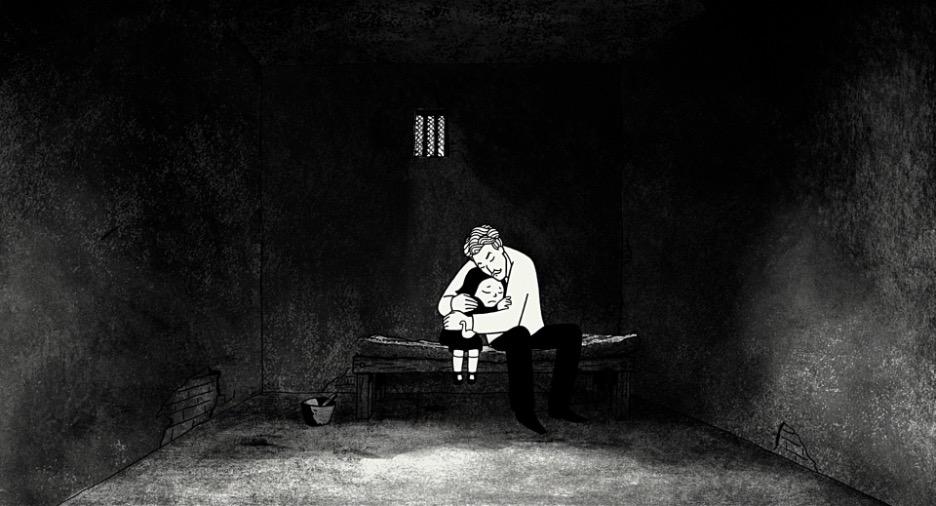
And yet, beneath this ordinary texture of survival, the Revolution was quietly taking away everyone she loved. Her uncle Anoush, a communist who had been previously imprisoned and exiled to the Soviet Union, eventually returns to Iran but is arrested again after the Revolution and sentenced to death. He is allowed one visitor before his execution and he requests to see Marji, his niece, who is still a child. Later in the film, there is a moment involving her uncle Taher that carries a particular, suffocating weight. He has already endured two heart attacks from the stress of the war and the separation from his son, whom he had sent to Holland for safety. When a third attack strikes and he needs surgery abroad, the regime refuses him a passport. His family tries everything, including having a fake passport arranged, but that too falls through. He dies without ever seeing his son. These are the men who shaped Marji, and neither of them survived the Revolution intact.
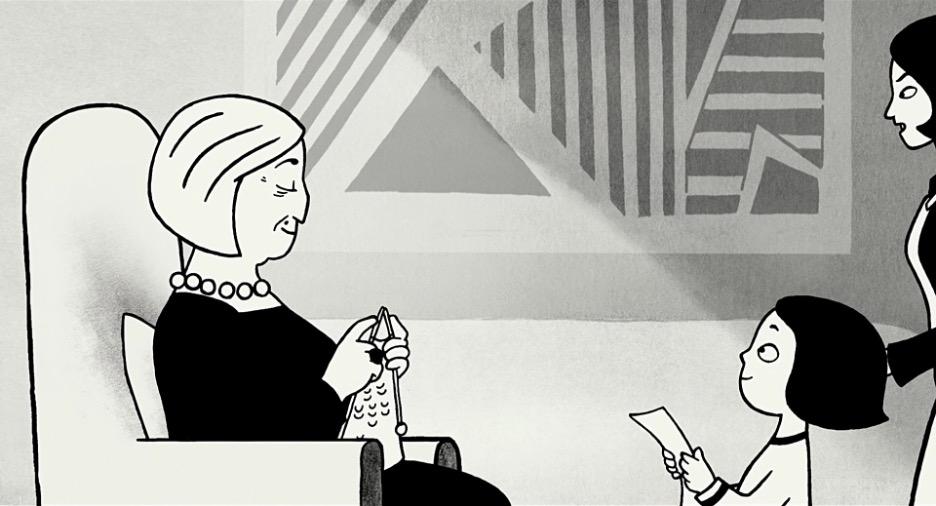
However, they are not her only inheritance. There is also her grandmother, who is perhaps the most quietly radical figure in the film. She never left Iran; she had no occasion to. And yet she understood freedom with a precision that many who claim to pursue it cannot match. Before Marji leaves for Vienna, it is her grandmother who gives her the instruction that will become a yardstick for Satrapi for the rest of her life: "Keep your dignity and be true to yourself."
By this point in the film, Marji arrives at an understanding that she could not have reached any other way but after years of displacement and the slow erosion that comes with living between worlds. What her grandmother had been trying to tell her was that if she was not comfortable with herself, she would never be comfortable anywhere. It took leaving—and nearly not surviving—to understand what the woman who stayed home had always known.
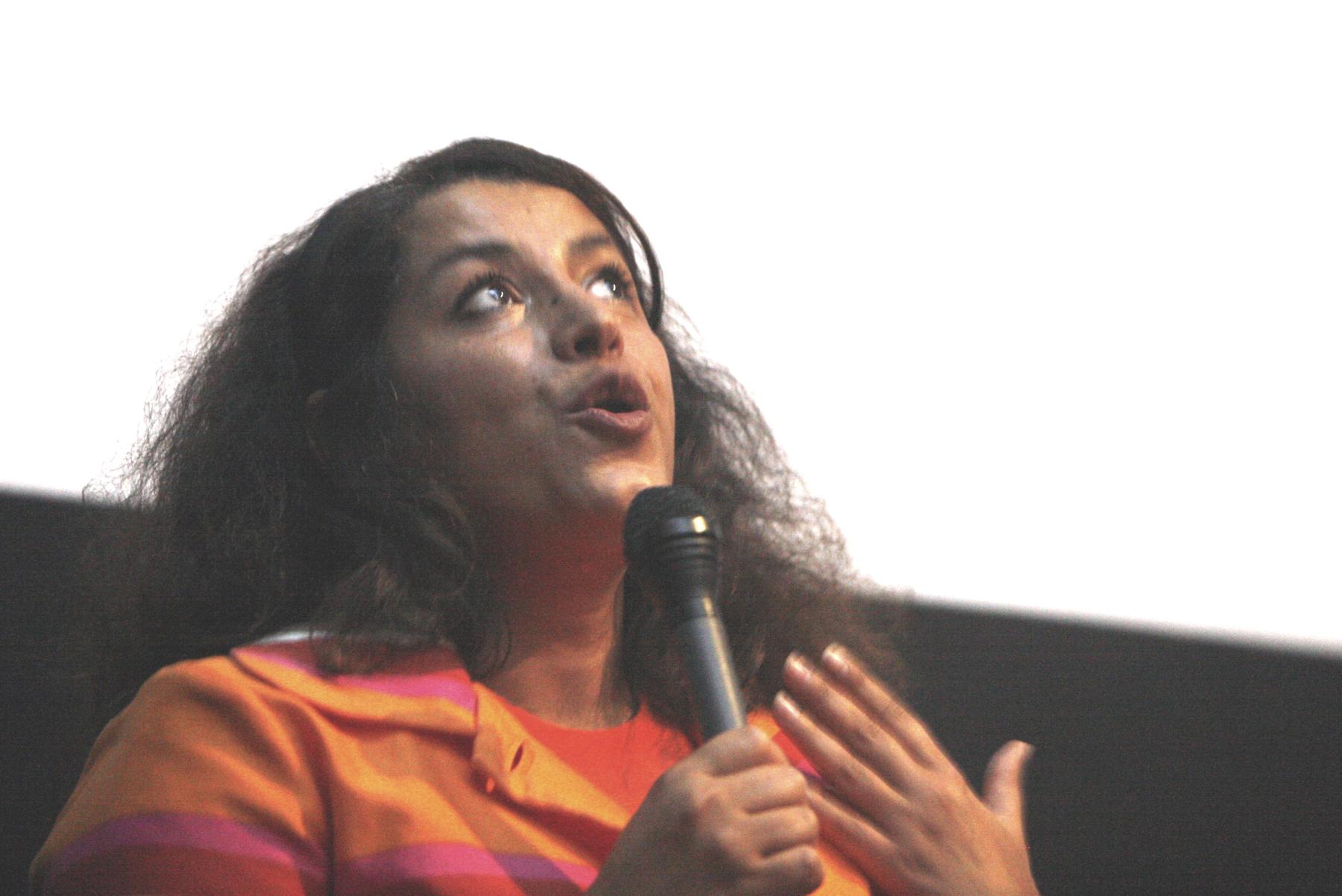
Satrapi's women were progressive before the word became something you performed for an audience. Her grandmother had opinions about class, dignity and how to live. Her mother took her to protests. The women in her family knew what freedom looked like from the inside, even when the outside was a country telling them that it was not theirs to have. Satrapi got out. That is the difference, and it is not a small one. But getting out came at a price that is not always accounted for. The freedom she found in France was real, so was its cost. A transnational life is not a liberated life, not simply. It is a life of perpetual translation, of carrying one world into another and realising that neither quite holds the weight of both. Satrapi paid this price for decades, quietly, and then this year on 4 June, she stopped. From exhaustion. From grief.
This is worth reflecting on because it leads to a question that the film handles with care: who, in Marji's story, actually chose anything?
Satrapi did not choose to leave Iran at the age of fourteen. Her parents sent her to Vienna because the alternative was watching their daughter imprisoned, or worse. She did not choose to return either. Vienna and the loneliness it produced had nearly broken her: a deep depression, a period of homelessness and a relationship that collapsed. She went home because she was twenty-two-years-old and had nowhere else that felt like home. And then she left again, for Paris, because staying in the Islamic Republic as the woman she had become was not survivable in any meaningful sense.
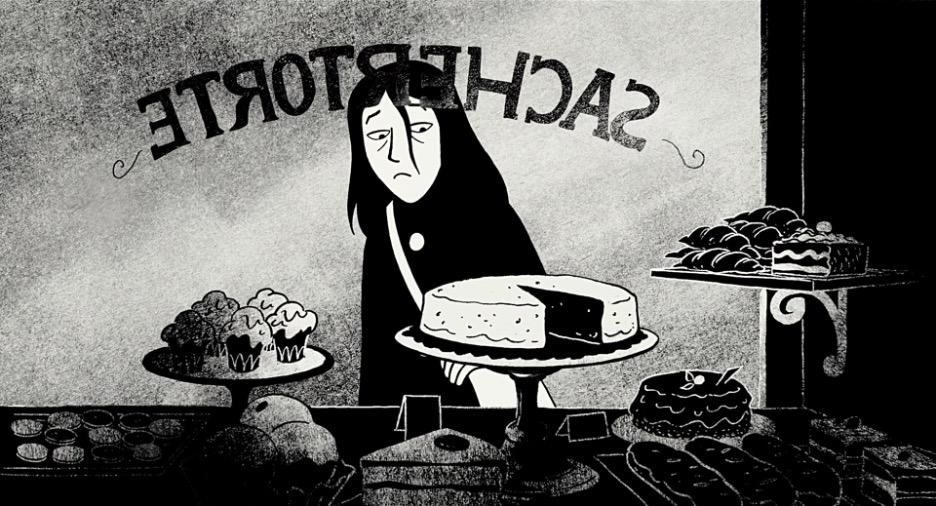
In France, she once lied about where she was from. She told people that she was French. The film does not let this pass lightly; it carries the self-reproach of someone who has not forgiven herself. The lie was not cowardice. It was exhaustion. Eventually, Satrapi would refuse to resolve the contradiction. In her essay, “I Must Go Home to Iran Again” (2009), she wrote: "No matter how long I live in France, and although I feel also French after all these years, to me the word 'home' has only one meaning: Iran." There is something precise in how that sentence is constructed. She does not deny France or minimise the years and what they made her. Neither does she deny Iran—as home. She simply holds both these emotions at once and tells us which one is heavier. She said this while living in Paris, knowing that she could not go back safely to Iran. The idea of home, for people like Satrapi, is not a place you inhabit. It is a place you carry—it is heavy, and it does not get lighter.
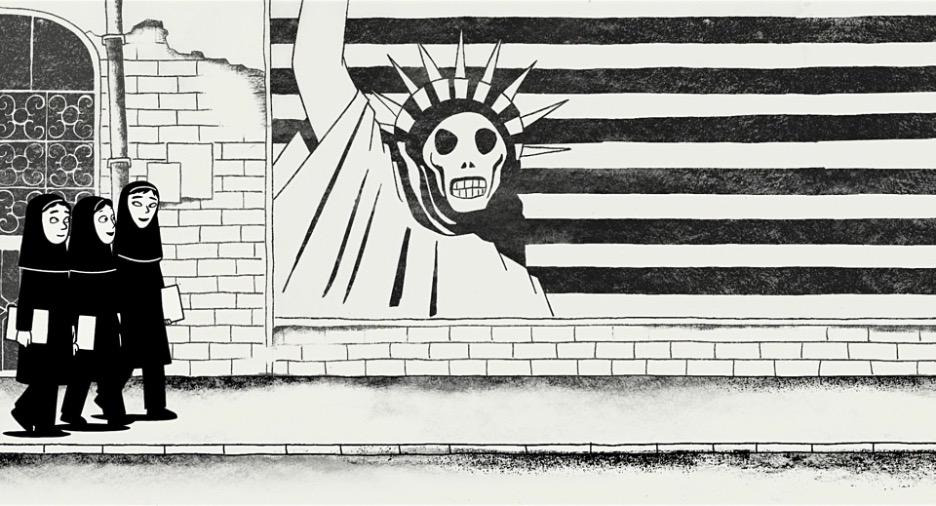
Persepolis was written not with the intention of critiquing Iran but to complicate its image in the world. Satrapi explicitly states that the film critiques religious fundamentalism and Western imperialism in the same breath. In fact, she rejected France's Legion of Honour in January 2025, citing what she called France's "hypocritical attitude towards Iran," a mark of her resistance to any attempt at categorising her work in the binary between testimony and ideology.
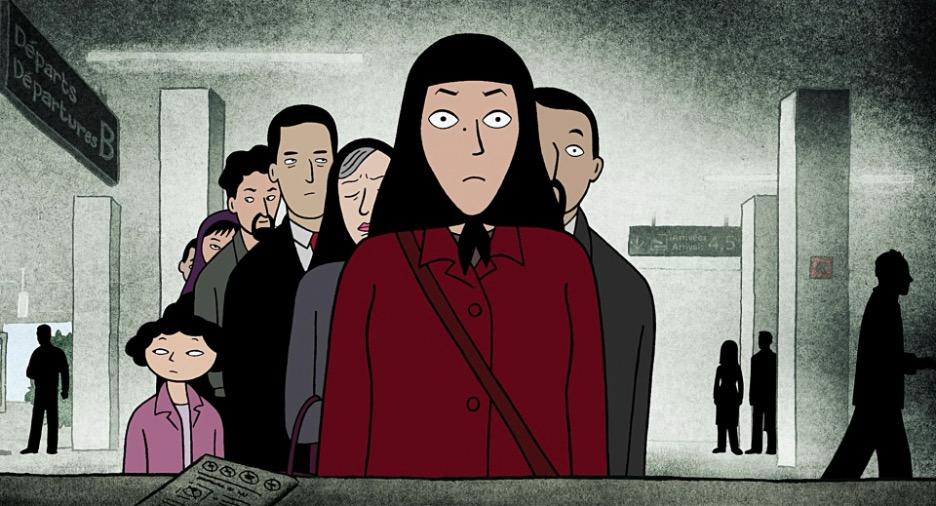
What becomes visible in all of this is a woman who was funny, loud, grieving, sharp and deeply serious about freedom—never taking herself too seriously, always with a cigarette in hand and with laughter that affirmed her refusal to be reduced to a symbol.
Drawing from her own experience unflinchingly and turning her own adolescent humiliations and her family's grief into art, she portrayed herself as difficult, self-destructive, occasionally dishonest and not particularly likeable. What she gave us was a person living inside a history that left her with few options and forced her to make imperfect choices. The same could be said of her life as a whole: she moved to France not because it was better but because survival in Iran was no longer possible. She stayed not because she had become French but because the option to return was foreclosed.
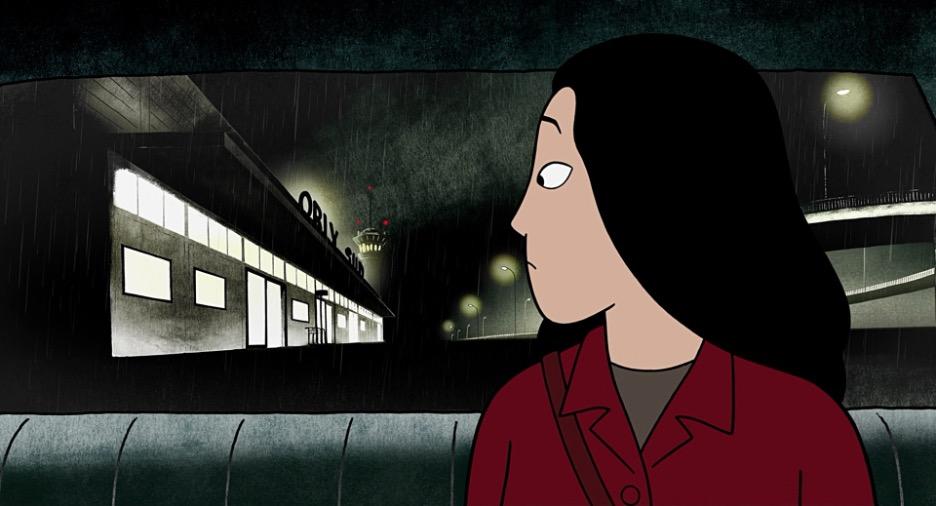
The final scene of Persepolis—Marji in a taxi, leaving Tehran for the last time, her mother watching her go and then turning away because she cannot watch any longer—feels unbearable, precisely because it is not dramatic. Nobody is shouting or making a speech. A woman is getting into a car while another is turning away. And somewhere underneath that image is the knowledge that this is not a narrative choice. It happened. The taxi drove away.
Marjane Satrapi spent the rest of her life drawing that taxi.
To learn more about gendered experiences within Iran, read Ishtayaq Rasool’s review of Yaser Talebi’s Sarnevesht (2022), Upasana Das’ review of Hooria Ahmadi’s Tehran Youth Diaries, Santasil Mallik’s reflections on Sreemoyee Singh’s And, Towards Happy Alleys (2023), Shefali Khan’s two-part essay exploring the history of Iranian cinema and Samira Bose’s essay on Firouzeh Khosrovani’s Radiograph of a Family (2020).
To learn more about experiences of exile, read Najrin Islam’s three-part series on the notion of exile in the work of Razan AlSalah, the exploration of Arabfuturism and reclamation of representation as a form of resistance, Ankan Kazi’s reflections on Abdallah al-Khatib’s Little Palestine: Diary of a Siege (2021), Mallika Visvanathan’s two-part essay on Amar Kanwar’s The Torn First Pages (2004–08) and Mila Samdub’s two-part essay tracing Tibetan resistance through his grandfather Lhamo Tsering’s archive.
All images are stills from Persepolis (2007) by Marjane Satrapi and Vincent Paronnaud, unless otherwise mentioned, and are sourced from FILMGRAB. Images copyright with the filmmakers.